

DDr. Arthur Luka
- Born on: 16.5.1882
- Birthplace: Lemberg (Lwow),
- Category: Doctorate program
- Right of domicile: Wien (Wien),
The English version is based on a translation by Artificial Intelligence. The authentic version is considered to be the German version.
Arthur Luka was the son of court councilor Dr. Wilhelm Luka (born 1856 in Lemberg/Lwów, died October 24, 1926 in Vienna) and his wife Berta (born 1855 in Lemberg, died August 8, 1936 in Vienna, maiden name Diamant). He had four younger siblings: Philipp (born February 26 or 28, 1884 in Lemberg), Rudolf (born March 3, 1889 in Sarajevo), Olga (born September 12, 1891 in Sarajevo), and Otto (born February 29, 1893 in Sarajevo).
Studies and Professional Activity
When Arthur Luka enrolled at the University for World Trade for a doctoral program for the winter semester 1936/37, he had already obtained three doctoral titles. At the University of Vienna, he had received his doctorate from the Faculty of Law and Social Science (1904) as well as from the Faculty of Philosophy (1914); he had also been awarded a doctorate in medicine at Philipps University Marburg (Germany) (1924/25). For the studies in Vienna, Arthur Luka was enrolled between the winter semester 1904/05 and the summer semester 1908 and between the winter semester 1908/09 and the summer semester 1911. The topic of his dissertation, with which he attained his Doctor of Philosophy under Adolf Stöhr and Friedrich Jodl at the Alma mater Rudolphina, was: Nietzsche im Verhältnis zu Vaihinger. Moreover, he was registered in Vienna as a medical student during the first year of World War I. Whether he actually attended courses at the Engineering School in Altenburg (Thuringia), where he enrolled for the winter semester 1915/16, is doubtful.
In Marburg, Luka was enrolled between the winter semester 1916/17 and the summer semester 1920, although initially for “Cameralia”, that is, for economics. How often he attended courses there is an open question—similar to the Engineering School in Altenburg, he was continuously on leave due to military service, even beyond the end of World War I; on March 1, 1921, he was removed from the matriculation register due to inactivity. It is documented that Arthur Luka submitted a dissertation at Marburg University in 1919, specifically for medicine. His work was supervised by the Würzburg dermatologist Karl Wilhelm Felix Zieler, who would later join the NSDAP during the ‘Third Reich’ and present himself as a committed and influential medical functionary in the service of National Socialism (Weyers 2000, p. 756). Luka's connection to Zieler likely arose when he studied medicine at Würzburg's Julius Maximilians University at least during the winter semester 1918/19; at that time, he lived in Würzburg at Franz-Ludwig-Strasse 16. As he stated in May 1919, he preferred not to obtain his doctorate at the university of the Free State of Bavaria, but at a university located in Prussia, namely the University of Marburg, because he had applied for Prussian citizenship. Although it seems that nothing came of a change of citizenship: As will be shown below, Austria remained his primary residence, and at the time of his enrollment at the University for World Trade, he held Austrian citizenship. However, Arthur Luka was able to successfully complete his doctorate in Marburg: The doctoral viva for his medical doctorate took place on July 24, 1924, the doctoral certificate is dated March 12, 1925. The title of his Marburg dissertation was: Ueber den Wert der Herdreaktion nach subkutaner Tuberkulinzuführung für die Erkennung von Lupus vulgaris.
His enrollment at the University for World Trade in the autumn of 1936 was not Luka's first contact with this Viennese institution. After attending the lower secondary school in Sarajevo (Bosnia and Herzegovina), the upper secondary school in Požega (Kingdom of Croatia and Slavonia), where he obtained his high school diploma in 1904, and the Vienna Business Academy in the eighth district of Vienna (Hamerlingplatz 5-6), he had completed the graduate course at the Imperial-Royal Export Academy, the predecessor institution of the University for World Trade. He also attended the teacher seminar during the 1916/17 academic year and the special course for book and balance auditors in the following academic year at the same institution. At that time, he seemed to have considered a professional activity as a teacher at a commercial school or business academy or in the field of bookkeeping as an option. It is unclear how these trainings in Vienna corresponded with military service in World War I, which—as mentioned above—had led to Luka's sustained leave from the University of Marburg. Apparently parallel to his enrollment in Würzburg, Luka was a regular student at the Vienna Export Academy in the winter semester 1918/19; however, it seems he did not continue this study after the collapse of the Austro-Hungarian dual monarchy. In any case, he did not take an examination at the Export Academy or the University for World Trade.
What Arthur Luka earned during his numerous studies in Germany and Austria can only be partially reconstructed. According to his own statements, he financed his doctoral studies at the Faculty of Philosophy at the University of Vienna through “Lectionserteilung” (i.e. teaching). Even before World War I, he was active in Vienna as a defense attorney, and in 1912 he appeared as the editor and publisher of the Kommerzielle Zeitung. In the early 1930s, Luka briefly belonged to the board of Stabilitas, a “savings and advance fund” based at Zollergasse 24 (7th district of Vienna). At this time, his official address as a lawyer was Bäckerstraße 10 (1st district), while his residence was Rotensterngasse 10 (2nd district).
The 'Anschluss' of Austria and Its Consequences:
Exclusion from Doctorate and Deportation
Arthur Luka's biography becomes tangible again when, for the winter semester 1936/37, he enrolled at the University for World Trade with the goal of obtaining a doctorate in commerce. At the same time, he was admitted to the examination for book auditors in 1937 (which he had presumably not completed during the last year of World War I and the Habsburg Empire), also at this university. On January 20, 1938, shortly before the German Wehrmacht's invasion of Austria, the Jewish doctoral candidate submitted his dissertation at the University for World Trade on Bosnien und die Hercegovina. Eine wirtschaftsgeographische Darstellung und Untersuchung im Querschnitt der Jahre 1910 und 1935. Although the two reviewers, the economic geographer Hermann Leiter and Rector Bruno Dietrich, recommended acceptance of the work, Luka was denied access to the rigorous examination due to racist reasons after the 'Anschluss' of Austria. The records of the university stated succinctly: "Da mosaisch zu den Rigorosen nicht zugelassen" ("Because he is Jewish, he is not admitted to the doctoral viva.")
The circumstances under which Luka survived in the following three years are unknown. What is clear is that he was registered at Radetzkystraße 23/5 (3rd district) in the anti-Semitically charged city of Vienna from March 28, 1938, to January 21, 1941, in a house that until the 'Aryanization' (see below) belonged to his sister Olga, married Grüner. He subsequently lived at Adolf-Kirchl-Gasse 9/11 (3rd district) until he was arrested on November 17, 1941, and eleven days later deported from the Vienna Aspangbahnhof to the ghetto in Minsk in the so-called Reichskommissariat Ostland along with approximately 1,000 other Jewish men, women, and children. Thousands died here due to mass shootings, forced labor, diseases, and hunger.
Arthur Luka also became a victim of the Holocaust. When and how exactly he died or was murdered is not documented. It is known, however, that he was not among the three Austrians who survived the forced stay in the ghetto in Minsk. On March 8, 1949, Arthur Luka was declared dead by the Commercial Court of Vienna.
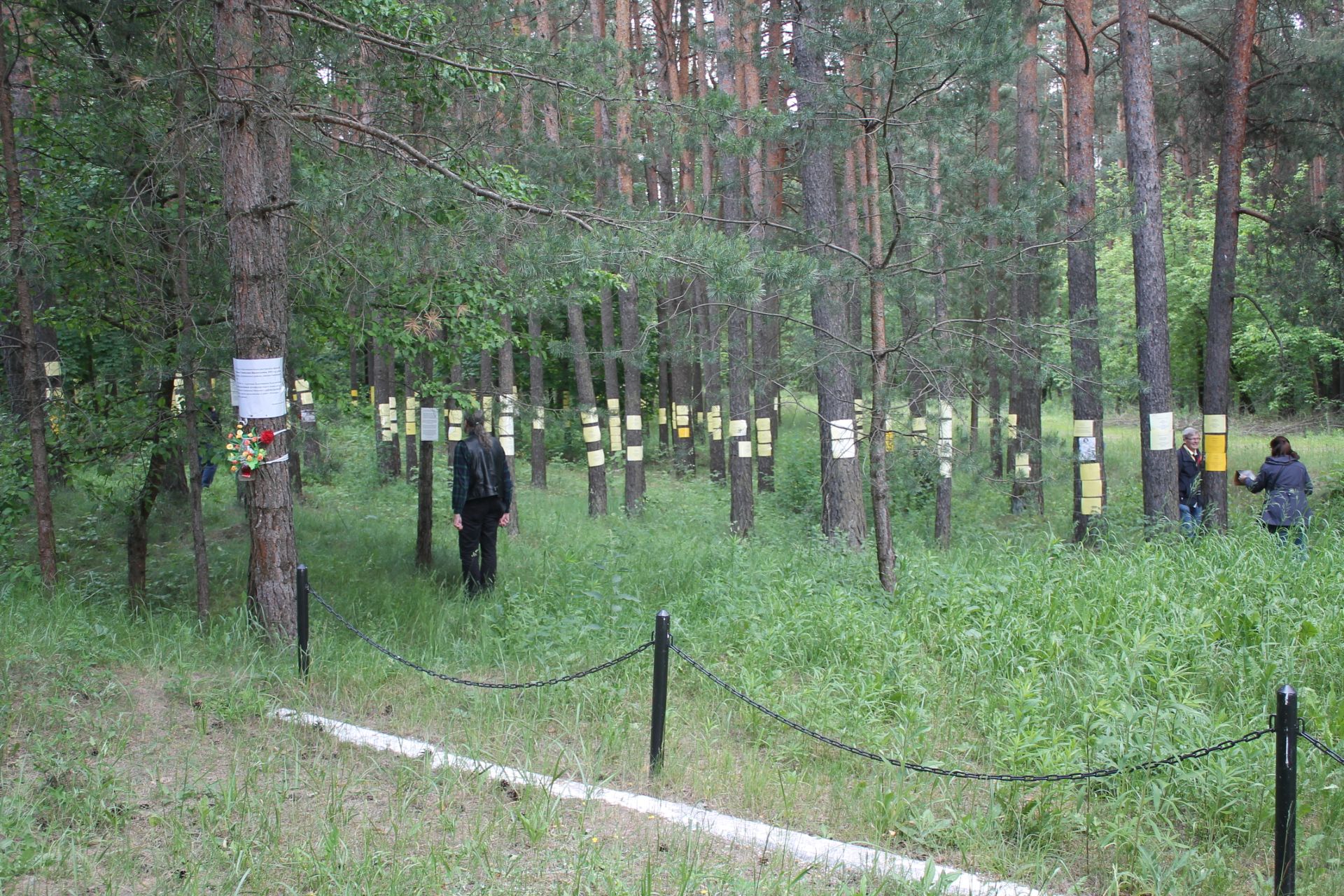
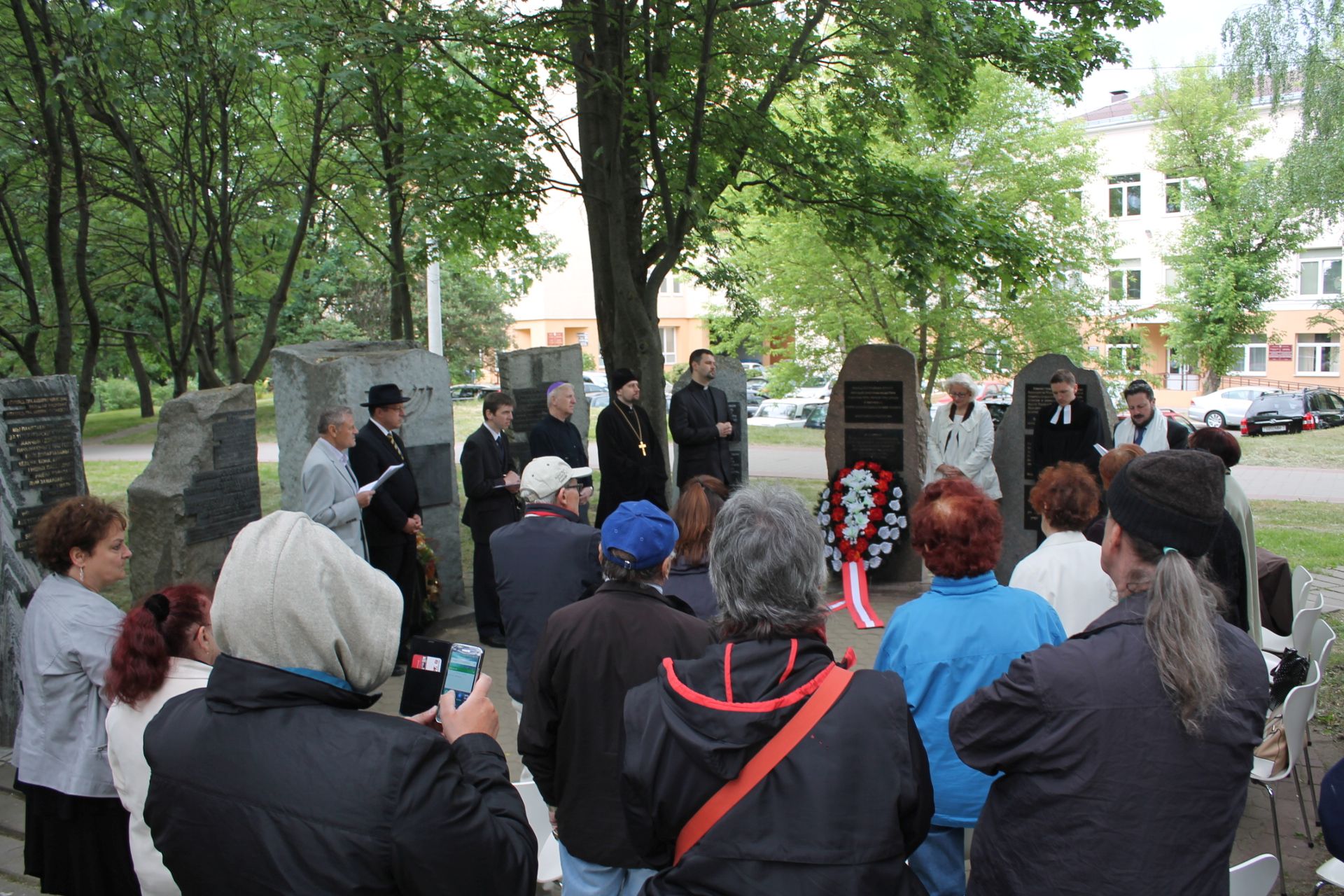
In memory of his fate, a plaque bearing Luka's name was hung on June 6, 2016, in Blagowschtschina—namely that little forest where the deportees were shot near Maly Trostinec (Reichskommissariat Ostland, Belarus today). A day later, his name was read at a memorial service held as part of the 8th memorial event of the association "Initiative Malvine - Maly Trostinec erinnern" (IM-MER) at the site of the former Minsk ghetto.
The Annihilation of the Luka Family
Not only was Arthur Luka murdered by the Nazi regime. All of his siblings also fell victim to its persecution measures.
- On December 29, 1938, Magister Otto Luka, who had taken over the Dr. Adolf Friedrich’s Apotheke „Zur Heiligen Maria vom Siege“ at Mariahilfer Straße 154 (15th district) in September 1926, was deregistered with an unknown destination. He intended to travel to Italy. Until then, he had been listed at the same residence in Olga’s house where Arthur had also temporarily lived (Radetzkystraße 23/5); in the Wiener Adreßbuch of 1938, Otto Luka also appears as a resident of the house at Rotensterngasse 14 (2nd district), where his parents had previously lived and where his mother had temporarily run a perfumery store. Otto’s pharmacy was 'Aryanized' by Franz Lemmerhofer and Rudolf Zaininger (both from Vienna). Its religiously connoted name, referring to the nearby Catholic church Maria vom Siege, was renamed „Sieg“-Apotheke Mr. Franz Lemmerhofer und Mr. Rudolf Zaininger, which could also be read in a non-religious sense from the perspective of the Nazis.
- Rudolf Luka, who worked as a dentist in Vienna and was registered at Rosenbursenstraße 4 (1st district), deregistered for Italy on December 31, 1939. Like Otto, he was also listed as a resident in the Rotensterngasse 14 house in the 1938 Wiener Adreßbuch. It is unknown whether Otto and Rudolf reached Italy at all, whether they could go into hiding in this fascist-ruled country, or were interned in camps or placed under house arrest in accordance with the anti-Jewish laws of 1938 (Galimi 2024, pp. 209-212), or if they managed to escape further from Italy, and when, where, and under what circumstances they perished. There is no evidence that the two brothers lived to see the end of World War II.
- Like his brother Arthur, Philipp Luka was also deported to the ghetto in Minsk on November 28, 1941, together with his wife Ottilie (born July 2, 1883, maiden name Kohn), whom he had married on October 11, 1938, in Vienna-Leopoldstadt. Both had also lived in Olga Grüner’s house up until then (Radetzkystraße 23/7), and both fell victim to National Socialist persecution.
- Olga Luka married Wilhelm Grüner (born May 7, 1905 in Vienna) at the Viennese City Temple (Seitenstettengasse, 1st district) on April 10, 1927. From his family, she took over the business for lingerie, textiles, and fashion goods as well as tailor and milliner supplies at Radetzkystraße 23, which had been founded in 1868 and was run by Olga's father-in-law Alois (also: Louis) Grüner (born September 28, 1873 in Vienna as the son of Wilhelm Grüner and Charlotte, maiden name Fröhlich). He had handed the business eleven years later over to his wife Paula Grüner (née Lanczy or Lanczi), whom he had married on February 14, 1904, in Bratislava/Pressburg. Since both Olga and Wilhelm Grüner, who had authorized signatory for the business, were considered Jewish, the company fell victim to 'Aryanization' after the 'Anschluss' of Austria. Thus, in August 1938, it was initially placed under the interim management of Vienna's Josef Brandstetter. A year later, Olga Grüner was forced to sell her business to the fanatical Nazi Wilhelm Möslein (born February 12, 1889 in Vienna), to whom she had also had to grant a lifelong right of first refusal contractually back in June 1938. The fact that the business was marketed under the name Modewarenhaus Wilhelm Möslein since August 1939, was supported by the trade association—since from their central office's perspective, a “modification of the Jewish company name was being urged for fundamental reasons.” Möslein also moved into the same building, which had belonged to Olga Grüner since April 1931: By occupying five housing units, he took up most space in Radetzkystraße 23. In all of this, Wilhelm Möslein enjoyed the benevolence of the new regime, which he served not least as the head of the NSDAP local group Innstraße. According to his own statements, he and his wife had to endure months of imprisonment due to their National Socialist convictions before the 'Anschluss' and were evicted for the same reason. Since the 'Anschluss', the Möslein couple shamelessly participated in the 'Aryanization' of Olga Grüner's business and were rewarded by the Nazi regime for their 'services' with high honors such as the Honorary Badge of November 9, 1923 ('Blood Order'), the Medal Commemorating March 13, 1938 ('Ostmark Medal'), and the Medal or Honor Award for German Folk Care. While Wilhelm Möslein seized Olga's business and spread out in her property, Olga Grüner was deported to the ghetto in Minsk on November 28, 1941; she was thus sent to her death in the same transport as her brothers Arthur and Philipp and her sister-in-law Ottilie Luka. Olga Grüner had not managed to flee in time. While her husband and her parents-in-law were able to find exile, she had remained behind due to the liquidation of the business in Radetzkystraße in Vienna and could not emigrate as originally planned with the onset of World War II. When and under what circumstances she also lost her life after deportation to the Reichskommissariat Ostland cannot be determined. However, her property at Radetzkystraße 23 was transferred to the property of the German Reich in December 1942 according to the 11th Regulation to the Reich Citizens Law.
The only people from Arthur Luka's family circle who survived the Holocaust due to emigration were his brother-in-law Wilhelm Grüner and Wilhelm's parents Alois and Paula Grüner. Also, his brother Viktor Grüner (born January 8, 1909 in Vienna) and his wife Machle Golde (born August 21, 1913 in southern Poland in Gródek [Voivodeship Małopolska/Kleinpolen] as the daughter of Feiuel and Rachel Billig, née Galler), who had married on February 28, 1937, at the Viennese City Temple, had run a fashion store at Wassergasse 23 in Baden until their emigration, and initially lived at Neustiftgasse 2 in Baden before later relocating to Kolonitzgasse 2 (3rd district of Vienna), a parallel street to Radetzkystraße, were able to leave the 'Greater German Reich' in time. While Viktor and Machle Grüner, who are also referred to in historical sources by the first name Olly, managed to emigrate to New York in October 1939 via Amsterdam and Rotterdam, Wilhelm reached Great Britain in 1939. Here, he enlisted in the army, which had been at war with Nazi Germany since September of the same year. In May 1943, Wilhelm Grüner changed his name to William Anthony Griffin. He later settled in Mexico City, where his parents had also fled.
Another brother of Wilhelm Grüner, Edwin Grüner, born May 16, 1906 in Vienna, also submitted an application for emigration assistance to the Jewish Community of Vienna after the 'Anschluss' of Austria. He was married to the seamstress Selma (born November 9, 1906), who gave birth to their son Heinrich Peter on February 12, 1934. After the 'Anschluss', he had to sell his textile shop at Salztorgasse 3 (1st district) as well as his household furnishings at Radetzkystraße 27/8, and liquidate valuables or securities to be able to pay off debts as well as the taxes and dues imposed by the Nazi regime in the course of its racist persecution policy against the Jewish population. From the perspective of the Jewish Community of Vienna, he was considered one of the “embarrassed poor” whose emigration from the 'Greater German Reich' she actively supported (Goldenberg on October 19, 1938). It is assumed that Edwin emigrated with his family on November 28, 1938, from Antwerp aboard the motor ship Orinoco to the Mexican port city of Veracruz and settled there like Wilhelm and their parents. His elderly, seriously ill mother-in-law had to be left in the care of the Jewish Community in Vienna.
William Anthony Griffin was the one who applied for the restitution of his murdered wife’s property after the war and took the necessary administrative steps to have Olga Grüner and her brothers officially declared dead. In accordance with the respective legal provisions of the Death Declaration Law of December 5, 1950, it was determined by the Commercial Court of Vienna in 1947 and 1949 that Arthur Luka, Philipp Luka, and Olga Grüner did not survive May 8, 1945, the end of World War II. In 1956, for Otto Luka, December 31, 1943, and for Rudolf Luka, December 31, 1944, were established as fictitious dates of death.
After the completion of the individual death declaration and inheritance proceedings for the mentioned individuals, the property at Radetzkystraße 23 was returned to William Anthony Griffin in 1957, who sold it in the same year.
While a large part of Olga’s extended family in America survived the Nazi regime, Arthur Luka, along with all his siblings, was systematically robbed as a result of the Nazi persecution policies. At least Arthur, Philipp, and Ottilie Luka, as well as Olga Grüner, were subsequently murdered.
Author: Johannes Koll
Research support: Stefanie Lucas
Downloads
Photos
Source material
Wirtschaftsuniversität Wien, Universitätsarchiv, Studierendenkarteikarte und Ordner "Allgemeine Akten 1938", Zl. 47/38.
Genteam.at. Die genealogische Datenbank, https://genteam.at [23. Juli 2024], Begräbnisse auf den Wiener Israelitischen Friedhöfen, Eintrag zum Tod von Vater Wilhelm Luka.
Archiv der Universität Wien, Philosophische Fakultät, Rigorosenakt Nr. 3695: Luka, Arthur, Curriculum vitae vom 22. Mai 1913.
Archiv der Universität Wien, Philosophische Fakultät, Rigorosenprotokoll Nr. 3695: Luka, Arthur.
E-Mail von MMag. Dr. Martin G. Enne (Archiv der Universität Wien) an PD Dr. Johannes Koll (WU Wien) vom 10. November 2022.
Genteam.at. Die genealogische Datenbank, https://genteam.at [9. November 2022], Mediziner aus Wien, Nr. 47709.
Stadtarchiv Weimar, 51 1/82 und 51 1/237 zu Arthur Lukas Inskription an der Ingenieurschule Altenburg; für den Hinweis danke ich Christian Repkewitz (Stadtarchiv Altenburg).
E-Mail von Dr. Katharina Schaal (Archiv der Philipps-Universität Marburg) an PD Dr. Johannes Koll (WU Wien) vom 11. November 2022.
W[olfgang] Weyers: Dermatologie in Deutschland unter dem Einfluß des Nationalsozialismus, in: Andreas Plettenberg/Wilhelm N. Meigel/Ingrid Moll (Hrsg.): Dermatologie an der Schwelle zum neuen Jahrtausend. Aktueller Stand von Klinik und Forschung. Berichte von der 40. Tagung der Deutschen Dermatologischen Gesellschaft, Berlin/Heidelberg 2000, S. 755-758.
Lehmanns Allgemeiner Wohnungs-Anzeiger nebst Handels- und Gewerbe-Adreßbuch für die k.k. Reichs-Haupt- und Residenzstadt Wien, 54. Jg., Bd. 1, Wien 1912, S. 1680.
Zentralblatt für die Eintragungen in das Handelsregister in Österreich, 30. Jg., Nr. 45 vom 11. November 1931, S. 928, Nr. 17.815.
Zentralblatt für die Eintragungen in das Handelsregister in Österreich, 31. Jg., Nr. 19 vom 11.05.1932, S. 458, Nr. 9233.
Wiener Adreßbuch. Lehmanns Wohnungsanzeiger, 72. Jg., Wien 1931, Bd. 1, S. 967.
Studiennachrichten der K.k. Exportakademie über das 19. Studienjahr 1916/17, Wien 1917, S. 49.
Studiennachrichten der K.k. Exportakademie über das 20. Studienjahr 1917/18, Wien 1918, S. 49.
Meldeauskünfte des Wiener Stadt- und Landesarchivs, GZ MA 8 – B-MEW-119202/2013 und MA 8 – B-MEW-552019-2024-2.
Opferdatenbank des Dokumentationsarchivs des österreichischen Widerstands, http://www.doew.at [30. August 2013].
Yad Vashem: The Central Database of Shoah Victims' Names, http://db.yadvashem.org/names/search.html?language=en [30. August 2013].
Waltraud Barton (Hrsg.): Maly Trostinec – Das Totenbuch. Den Toten ihre Namen geben. Die Deportationslisten Wien – Minsk/Maly Trostinec 1941/1942, 2. Aufl. Wien 2015, S. 225.
E-Mail von Waltraud Barton, MA (IM-MER) an PD Dr. Johannes Koll (WU Wien) vom 13. Juni 2016.
Dokumentationsarchiv des österreichischen Widerstandes (Hrsg.): Deportation und Vernichtung – Maly Trostinec (= Jahrbuch 2019), Wien 2019.
Zentralblatt für die Eintragungen in das Handelsregister in Österreich, 25. Jg., Nr. 40 vom 6. Oktober 1926, S. 976, Nr. 18499.
Wiener Adreßbuch. Lehmanns Wohnungsanzeiger 1938, 79. Jg., Wien 1938, 2. Bd., Teil IV, S. 116.
Zentralblatt für die Eintragungen in das Handelsregister in der Ostmark, 37. Jg., Nr. 47 vom 23. November 1938, S. 957, Nr. 14959.
Valeria Galimi: Trajectories of Foreign Jews in Fascist Italy during the Holocaust, in: Michaela Raggam-Blech/Peter Black/Marianne Windsperger (Hrsg.): Deported. Comparative Perspectives on Paths to Annihilation for Jewish Populations under Nazi German Control (= Beiträge des VWI zur Holocaustforschung, Bd. 9), Hamburg 2024, S. 209-231.
GenTeam. Die genealogische Datenbank, https://genteam.at [18. April 2024], Die Ziviltrauungen in Wien zwischen 1870 und 1939 zur Eheschließung von Philipp Luka und Ottilie Kohn.
Opferdatenbank des Dokumentationsarchivs des österreichischen Widerstands, http://www.doew.at [18. April 2024] zu Ottilie und Philipp Luka.
GenTeam. Die genealogische Datenbank, https://genteam.at [12. April 2024]: Index der jüdischen Matriken Wien und Niederösterreich zur Eheschließung von Olga Luka und Wilhelm Grüner.
Zentralblatt für die Eintragungen in das Handelsregister in Österreich, 28. Jg., Nr. 35 vom 28. August 1929, S. 661, Nr. 14.844.
Wiener Stadt- und Landesarchiv, Handelsregister A 18/28, 2.3.3.B76.18.28, S. 28.
MyHeritage.at: Eintrag zu Louis Grüner nach Geni Welt-Stammbaum, http://www.myheritage.at/ [2. Juli 2024].
Zentralblatt für die Eintragungen in das Handelsregister in Österreich, 37. Jg., Nr. 37 vom 14. September 1938, S. 756, Nr. 11.471.
Wiener Stadt- und Landesarchiv, Handelsregister A 18/28, 2.3.3.B76.18.28, S. 28.
Zentralhandelsregisterbeilage zum Deutschen Reichsanzeiger und Preußischen Staatsanzeiger, zugleich Zentralhandelsregister für das Deutsche Reich, Nr. 189 vom 17. August 1939 (Zweite Beilage), S. 8.
Zentralblatt für die Eintragungen in das Handelsregister in der Ostmark, 38. Jg., Nr. 34 vom 23. August 1939, S. 536, Nr. 10.526.
Österreichisches Staatsarchiv/Archiv der Republik/Entschädigungs- und Restitutionsangelegenheiten/Finanzlandesdirektion für Wien, Niederösterreich und Burgenland, 20112 Olga Grüner.
Österreichisches Staatsarchiv/Archiv der Republik/Entschädigungs- und Restitutionsangelegenheiten/Vermögensverkehrsstelle/Ha 2824 Olga Grüner.
Österreichisches Staatsarchiv/Archiv der Republik/Entschädigungs- und Restitutionsangelegenheiten/Vermögensverkehrsstelle/Vermögensanmeldung 18220 Olga Grüner vom 15. Juli 1938.
Reichsamtsleiter Erwin Knauer an die Vermögensverkehrsstelle vom 4. Juli 1938, Österreichisches Staatsarchiv/Archiv der Republik/Entschädigungs- und Restitutionsangelegenheiten/Vermögensverkehrsstelle, Ha 2824 Olga Grüner.
GenTeam. Die genealogische Datenbank, https://genteam.at [6. Mai 2024]: Index der jüdischen Matriken Wien und Niederösterreich zu Viktor Grüner und Machle Golde Billig.
Viktor Grüner: Declaration of Intention vom 13. Februar 1941, hier nach: Ancestry.com: New York, U.S., State and Federal Naturalization Records, 1794-1943, http://www.ancestry.com/ [6. Mai 2024].
MyHeritage.at: Österreich, Wien, Jüdische Auswanderungsanträge 1938-1939, http://www.myheritage.at/ [2. Juli 2024] inklusive Schreiben von Goldenberg vom 19. Oktober 1938 zu Edmund Grüner.
Wiener Stadt- und Landesarchiv, Landesgericht für Zivilrechtssachen Wien: Todeserklärungen 48 T 807/47 (Olga Grüner), 48 T 2202/48 (Arthur Luka), 48 T 2204/48 (Philipp Luka), 48 T 1498/55 (Rudolf Luka) und 48 T 1499/55 (Otto Luka).
Wiener Stadt- und Landesgericht: Bezirksgericht Innere Stadt: Verlassenschaften 2A 286/1949 Arthur Luka, 3A 850/1956 Rudolf Luka, 2A 285/1949 Philipp Luka, 3A 851/1956 Otto Luka, 15A 706/1947 Olga Grüner).
Wiener Stadt- und Landesgericht: Bezirksgericht Innere Stadt 3P 50/1955 Rudolf Luka.