

Dfkm. Dr. Wilhelm (Willy) Nagelberg
- Born on: 10.12.1914
- Birthplace: Vienna (Wien),
- Category: Doctorate program
- Right of domicile: Wien (Wien),
The English version is based on a translation by artificial intelligence. The authentic version is the German version.
Wilhelm was the son of Helene (1891-1959, maiden name Licht) and Fritz (1883-1960) Nagelberg. The father ran a ladies' clothing business in Czerningasse 4 (2nd District of Vienna), which had to go into bankruptcy in 1932.
At the University for World Trade, Wilhelm was enrolled between the winter semester of 1932/33 and the winter semester of 1936/37. Here he initially successfully completed the diploma program, and the diploma certificate was issued in January 1936.
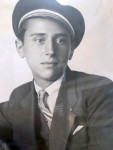
During his studies, Nagelberg joined the Wiener Akademisches Corps Marchia (see portrait photo above). This student fraternity was founded in November 1888 as an "academic society" and its members met at Café Colonnaden (Rathausplatz 4, 1st District of Vienna). It was one of the few “paritarian” corps that were open to both Jews and non-Jews (Doeberl et al. 1931, p. 1066). In the political spectrum of the time, Marchia was considered to be German-liberal, meaning it was nationally liberal-minded, and was a student corporation of arms-bearers. In 1935 and 1936, Nagelberg, who had adopted the color name "Wurm," held the office of the secretary twice (Wiener Akademisches Corps Marchia, 1988).
The doctorate of Wilhelm Nagelberg coincided with the period of the 'Anschluss' of Austria: He took his First Rigorosum in July 1937, but the Second Rigorosum only in July 1938. Nagelberg was one of the few Jewish doctoral candidates who were allowed by the Nazi regime to complete their doctorate after the Wehrmacht's invasion of Austria; this had to happen during the summer semester of 1938. Thus, Nagelberg was one of the seven Jewish doctoral candidates who were awarded their doctorate at the 'Welthandel' on July 12, 1938. According to a directive from the Austrian Ministry of Internal and Cultural Affairs, which was then under the supervision of Reich Governor Arthur Seyss-Inquart, the doctorate of Jewish doctoral candidates was subject to a series of restrictions that were meant to strip this academic event of its dignity:
- the doctorate had to take place without public attendance;
- the candidates were not allowed to invite relatives or acquaintances to the doctorate;
- the academic officials such as rector and promoter were required not to appear in academic robes;
- instead of the usual oral graduation ceremony, the Jewish doctoral candidates had to take the oath in writing by signing a pre-printed form.
- Speeches were not permitted.
Part of the dissertation was published by Nagelberg in 1938 under the title Über Veränderungen in der Baumwollwirtschaft der Erde seit 1900.
Soon after his doctorate, Nagelberg traveled to Italy. He vacated his apartment at Czerninplatz 2, where he had been living with his parents since October 1933, on September 12, 1938. In Milan, he met his parents. On March 23, 1940, he set off from Genoa to the USA on the SS Vulcania, where he Americanized his name to William Nagel. He received American citizenship on March 30, 1941, in Augusta (Georgia). As his daughter Arlene reported in 2021, he was proud throughout his life to be (become) an American; almost until his day of death, the flag of the United States hung on the front of his home.
Initially, he worked as a doorman for the Ocean Management Corporation before enlisting in the American Army in October 1940. He received his training at Camp Ritchie (Maryland), where the US military intelligence trained soldiers for interrogation. The former 'Welthandel' graduate Nagelberg thus belonged to the so-called “Ritchie Boys,” who interrogated German and Austrian prisoners of war behind the lines during the liberation of Europe from National Socialism.
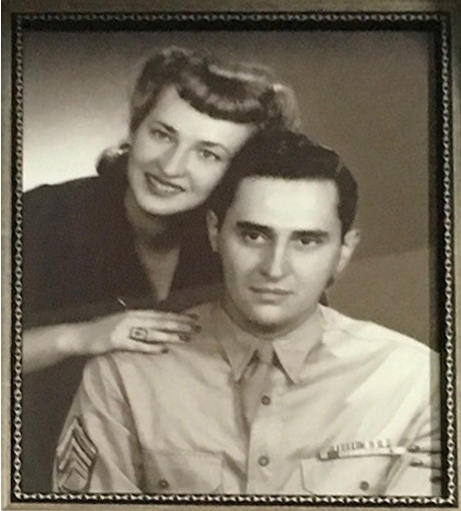
After being discharged from military service in 1945, William Nagel worked until his retirement at the Pentagon and in the Europe Division of the Office of Economic Affairs. He settled in Washington D.C. Here he lived with his wife Gertrude (born March 12, 1921, daughter of Anna [July 4, 1899, presumably 1944, maiden name Pollach] and Mendel [known as Max] Juris [1885-1926]) and daughters Arlene (later married Bekman) and Deborah (later married Graff). Like William, Gertrude originally came from Vienna, and she too had fled to the USA before the persecution of Jews by the Nazi regime. Initially, Gertrude crossed the border into Switzerland in January 1939, and after her younger brother Kurt (1924-1945?) and her uncle Joschi joined her in St. Gallen, she emigrated to Great Britain. Here she found employment with a family in Blackpool before she could emigrate to the USA. After William and Gertrude met in exile, the couple married on January 18, 1942, in New York.
While William's parents survived World War II in Italy and were able to emigrate to the USA in 1953, Gertrude's efforts to save her mother Anna and grandmother Hermine Pollach (presumably October 1872 to presumably 1944, maiden name Kohn) during the war were unsuccessful. The two women were deported from Herminengasse 10/20 (2nd District of Vienna) to the ghetto of Łódź on October 10, 1941. Through relatives in Switzerland, Gertrude was able to maintain contact with the two women until the spring of 1944. After the war, she suspected that her mother and grandmother were murdered in the Auschwitz/Oświęcim concentration camp thereafter.
William's application to the "Fund for Assistance to Politically Persecuted Persons Residing Abroad (Relief Fund)" was positively decided in November 1956. However, he received no payments from the Republic of Austria until October 1962. His complaint apparently went unheard.
Nagelberg's last residence was Silver Spring (Maryland). He died on September 19, 2001. Two days later, William Nagel was buried at the Judean Memorial Gardens near Olney (Maryland), which had been established in 1975 as the Jewish cemetery for the Washington metropolitan area. Thus, he was buried exactly four months to the day after the burial of his wife, who passed away on May 18, 2001.
Author: Johannes Koll
Support in research: Harald Seewann
Photos
Source material
Wirtschaftsuniversität Wien, Universitätsarchiv, Studierendenkarteikarte.
Wirtschaftsuniversität Wien, Bibliothekszentrum LC, Sign. 41012-B.
Doeberl, Michael/Otto Scheel/Wilhelm Schlink/Hans Sperl/Eduard Spranger/Hans Bitter/Paul Frank: Das akademische Deutschland, Bd. 2: Die deutschen Hochschulen und ihre akademischen Bürger, Berlin 1931.
Wiener Akademisches Corps: Marchia 1888–1988. Festschrift zur Feier des zweihundertsten Semesters, Wien 1988.
Meldeauskunft des Wiener Stadt- und Landesarchivs, GZ MA 8 – B-MEW-140563/2013.
Österreichisches Staatsarchiv, Archiv der Republik, Finanzen, HF, Zl. 1263.
E-Mail von Arlene Nagel Bekman (Tochter) an PD Dr. Johannes Koll (WU Wien) vom 2. Juni 2021.
European Holocaust Research Infrastructure, Gertrude and William Nagel family papers, irn575723, https://portal.ehri-project.eu/units/us-005578-irn575723 [2. Juni 2021].
Robert Lackner: Camp Ritchie und seine Österreicher. Deutschsprachige Verhörsoldaten der US-Armee im Zweiten Weltkrieg, Wien/Köln/Weimar 2020.
Opferdatenbank des Dokumentationsarchivs des österreichischen Widerstands (http://www.doew.at ) zu Anna Juris [2. Juni 2021].
Zentrale Datenbank der Namen der Holocaustopfer (https://yvng.yadvashem.org/ ) zu Anna Juris und Hermine Pollach [2. Juni 2021].
http://www.ancestry.com zu William Nagel [2. Juni 2021].
Ancient Faces, http://www.ancientfaces.com/person/william-nagel/13455968 [23. September 2013].