

Dkfm. Dr. Vinzenz Zwitter
- Born on: 19.7.1904
- Birthplace: Göriach
- Category: Doctorate program
- Right of domicile: St. Jakob (Kärnten) (St. Jakob (Kärnten)),
The English version is based on a translation by artificial intelligence. The authentic version is the German version.
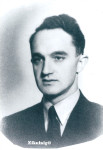
Vinzenz (Slovenian: Vinko) Zwitter was born on July 19, 1904, in the Carinthian village of Draschitz/Draščiče, which belonged to the parish of Göriach/Gorje and the political municipality of Hohenthurn/Straja vas. He was the son of Maria (née Janschitz) and the innkeeper Valentin Zwitter, who also ran a dairy and cheese factory. His mother was born on September 17, 1882, in Köstenberg/Kostanje and passed away in 1911 in St. Jakob im Rosental/Šentjakob v Rožu. His father was born on January 7, 1872, in Achomitz/Zahomc a.d. Gail and died in 1938 in St. Jakob im Rosental. In 1906, the family moved to St. Jakob im Rosental. Here, Vinzenz's parents rented the inn in the village center and set up a cheese factory.
Vinzenz initially attended the primary school in St. Peter im Rosental/Šentpeter, one of the cadastral municipalities of St. Jakob. He then went to the Klagenfurt gymnasium, where he obtained his high school diploma in the first half of 1924. He subsequently enrolled at the University for World Trade, where his cousins Franz and Martin-Mirt also studied. At the 'University for World Trade', Vinzenz was enrolled for eight semesters before World War II (winter semester 1924/25 to summer semester 1931). In addition to his regular studies in commerce, he attended classes at the so-called teacher seminar, which specialized in training teaching staff for trade schools. He was also enrolled for the teacher seminar again in the winter semester 1946/47 and took examinations in business correspondence and commercial arithmetic in 1949/50. Zwitter passed the diploma examination in July 1928. The academic title of 'Diplomkaufmann' was only introduced in Austria in March 1936 by a regulation of the federal government; graduates who had previously passed the diploma examination were at least given the opportunity to apply for the use of the title by submitting a free written work and taking written exams according to the Diplomkaufmannverordnung. Zwitter was among the former students of the 'University for World Trade' who immediately took advantage of this option: Based on his thesis on the topic Capitalistic Accounting and Agriculture, he was already issued the diploma certificate in August 1936, and the corresponding certificate was issued by the then rector Bruno Dietrich in November 1936.
While studying, Vinzenz was chairman of the club of Slovenian Carinthian academics in Vienna/Klub slovenskih koroških akademikov. He was initially registered at Schmidgasse 4/12 (8th district of Vienna). It is possible that he took over the apartment from his older brother Valentin, who was also enrolled at the University for World Trade as an extraordinary student during the winter semester 1923/24 and summer semester 1924 while simultaneously studying political science at the University of Vienna. In March 1926, Vinzenz moved to Dreilackengasse 4/12 (9th district), and in October of the following year to Riglergasse 4/15 (18th district), where he was registered until June 1931 with an interruption of several months. After World War II, he lived in Belvederegasse 30 (4th district).
In 1933, he married Terezija (Rezi) Prušnik, who was born in 1913 in Eisenkappel/Železna Kapla. The couple had six children together. In their hometown of Klagenfurt, the family lived on Achazelgasse.
In early October 1939, Zwitter submitted his dissertation on the topic The Influence of Capitalism on Agriculture with Special Consideration of the Yield Problem to the University for World Trade. However, he only completed the rigorous examinations in February and March 1941. Based on this, he was promoted to Doctor of Commerce on March 21, 1941. While the university waived the costly printing of his dissertation, the doctoral diploma was withheld from him. As the National Socialist rector Kurt Knoll informed him, he would only receive the corresponding certificate after submitting an 'improved dissertation'. However, this never happened during World War II. It was only in early October 1948 that Zwitter submitted four typewritten copies of the revised doctoral thesis to the 'University for World Trade'. Based on this, he received his doctoral certificate in mid-July 1949; it was, however, backdated to the original promotion date, i.e., March 1941. What changes Zwitter made in the meantime cannot be reconstructed. The copy held in the library of the Vienna University of Economics and Business is written on different types of paper. Although the submission year of 1941 is mentioned, the work itself, as well as the bibliography, includes titles that were published in later years. Since it is apparent that the original version from 1941 is not preserved, it remains open whether Zwitter yielded to the demands of the reviewer Arnold Pöschl from 1942 to eliminate all passages that reminded of the corporatist state and social teachings of Othmar Spann and to consider instead National Socialist-oriented books; the bibliography of the copy in the university library certainly contains titles by Spann, but not those demanded by Pöschl from regime-conform authors like Artur Schürmann and the former Reich Minister of Food and Agriculture Herbert Backe.
It is likely that after the rigorous exams, Zwitter had almost no opportunity for scientific work. For just over two weeks after his promotion, he was arrested by the state police station in Klagenfurt, in front of his wife and children after the festive church service on Palm Sunday. The arrest happened not coincidentally on the same day that the German Wehrmacht invaded Yugoslavia (April 6, 1941). In Carinthia, the military invasion of the neighboring country led to 'an intensification of the persecution of officials and members of Slovenian cultural institutions' (Malle et al. 2004, p. 236).
Vinzenz Zwitter was among the victims of this policy. Since 1928, he had been editor of the weekly newspaper Koroški Slovenec [The Carinthian Slovenian] and had worked as secretary of the Slovenian Christian Social Association for Carinthia/Slovenska krščansko-socialna zveza from 1929 to 1941 (renamed in 1934 to Slovenian Cultural Association/Slovenska prosvetna zveza). He was also represented in other cultural organizations of the Carinthian Slovenes, as well as on the supervisory board of the Carinthian Cooperative Association/Zveza koroških zadrug. Moreover, he was elected chairman of the savings and loan association in Klagenfurt/Hranilnica in posojilnica društvo v Celovcu in 1939 and had led the Slovenian student dormitory in Klagenfurt for some time. Finally, it can be seen from the stamps in his passports that he traveled several times to Yugoslavia in the 1930s.
Although Zwitter belonged to those representatives of the Carinthian Slovenes who hoped to be able to come to an arrangement with the Nazi regime after the 'Anschluss' of Austria in March 1938 to protect their ethnic group from possible discrimination and reprisals, he had expressed the following: 'We Carinthian Slovenes follow the pronounced national movement of the new state with sympathy and will support it as much as we can, but with the reservation that the Slovenian national honor and economic prosperity of the Slovenian population are preserved [...]. We want to fulfill our citizen's duty loyally and participate in all organizations of National Socialism, except for the militant groups SA and SS, which are reserved for the German compatriots because of their special character.' (cited in Wieser 2014, p. 172) Initially, the Nazi regime seemed to respond to such hopes – indeed, Dr. Franz Hammerschmid, the personal advisor to Reich Governor Dr. Arthur Seyß-Inquart, had stated on April 14, 1938, during a reception for representatives of the Carinthian Slovenes at the Reich Governor's Office in Vienna, the building of the current Federal Chancellery, that 'National Socialism stands on a racial basis, considers Slovenes as a related people, and therefore treats them according to the same standard as German fellow countrymen.' (Federal Archives Koblenz, N 1180/30)
However, at the latest with the wave of arrests that the National Socialists unleashed after the start of the German invasion of Yugoslavia among the Carinthian Slovenes, it became clear that the regime was by no means willing to respect the Slovenian minority. The Koroški Slovenec, which represented 'the cultural, national, and economic interests of the Slovenian ethnic group' in Carinthia with a circulation between 5,000 and 5,600 copies (Malle 2016, p. 1093), had to cease publication in 1941, and the aforementioned Klagenfurt Savings and Loan Association was put under the control of Karl Geissner; shortly thereafter, the regime-compliant provisional manager would forcibly merge the Slovenian organization with the Raiffeisen Bank Klagenfurt. Zwitter, who was detained for three months by the Secret State Police, had to helplessly watch as the Savings and Loan Association lost its independence and was effectively 'coordinated'.
Like other representatives of the Slovenian minority, Zwitter had to leave the 'Ostmark' after his release from detention. The employment office required him to take up a position as a commercial employee with Deutsche Lufthansa in Munich on October 1, 1941. In the course of World War II, he was transferred to Náchod (Protectorate of Bohemia and Moravia). There, he held a managerial position in the personnel department of the so-called overhaul workshops of Lufthansa, where in 1943/44 almost exclusively Czech workers were forced to work (Budraß 2016, p. 88 and 92-99). Zwitter was exempted from military service because he was deemed 'unfit for military service' (Malle et al. 2004, p. 478).
Aside from Vinzenz, other family members were also forced to leave the Alps and Danube regions (as Austria was called since 1942). His in-laws, Franz and Marija Prušnik, were resettled in 1942 as part of the mass deportation of Slovenian families. His wife Terezija, whose brother Karl joined the partisan movement under Josip Broz Tito under the alias Gašpar and narrowly escaped arrest in November 1942, left Klagenfurt in January 1944 with the then four children, after the city had been attacked by Allied bombers. She initially settled in St. Jakob, where her father-in-law lived. Here she found accommodation on her brother-in-law Janko's property, who was deployed by the Wehrmacht on the Eastern Front. However, she could not stay there long. Like her husband, Terezija also had an unpleasant encounter with the Secret State Police: she was denounced and repeatedly misled by a Slovenian-speaking Gestapo informant. Once he claimed that her brother Karl had been severely injured and needed bandages and warm gloves and socks. Out of concern for her brother, she handed over materials to the informant – thus exposing herself to the accusation of supporting the partisan movement. In the spring of 1944, she was arrested and interrogated by the Gestapo. Ultimately, Terezija was released on the condition that she leave the bilingual area of Carinthia. She found a new place of residence in the rectory of Zammelsberg near Weitensfeld in the Gurktal/Krška dolina. Here, her pastor Matej Nagele, who had also been expelled from the bilingual area, provided her a room. In Gurktal, she was able to stay with her children until the end of the war. Her daughter Agnes Zikulnig recalled in 2015: 'Together, we spent the time in extremely meager conditions and great isolation until the end of the war. Neither our schoolmates nor teachers and neighbors were allowed to be informed about the reason for our stay and our belonging to the Slovenian ethnic group.'
Shortly before the end of World War II, Vinzenz Zwitter returned to Carinthia: On April 12, he left Náchod to travel to his family in Weitensfeld. In Carinthia, he was among the leading politicians of the Osvobodilna Fronta za Slovensko Koroška [Liberation Front for Slovene Carinthia] until 1947, which had fought against the Axis powers Germany and Italy during the war and now positioned itself as the official representative of the Slovenian-speaking Austrians toward the British occupying power. For instance, Zwitter participated in negotiations in February 1946 with Colonel H.B. Simson, the head of the British occupation administration, regarding the dissolution of the above-mentioned forced association of the Slovenian Savings and Loan Association with the Raiffeisen Bank Klagenfurt and the restoration of an independent Slovenian cooperative system in Carinthia.
Moreover, Zwitter was a co-founder of the Council of Carinthian Slovenes/Narodni svet koroških Slovencev as well as the Farmers' Economic Union/Kmečka gospodarska zveza, where he was active as a secretary from 1959 to 1964. He served as secretary of the Council of Carinthian Slovenes from its founding in June 1949 until 1954 and again from 1958 to 1962, after the break with Tito Communism. Without a doubt, he belonged to the wing of 'Catholic fundamentalism' (Malle 1998, p. 504). His engagement for the Catholic faith and Catholic Church had already been prominent in pre-war times. For instance, he had campaigned for the Catholic Slovenian Educational Association in Radsberg (Katoliško slovensko izobraževalno društvo na Radišah), which was fundamentally renewed at his suggestion following the plebiscite of 1920 (Ogris 2016, p. 1100). His bond to Catholicism can also be seen by the fact that Vinzenz Zwitter was elected to the board of the Catholic Hermagoras Brotherhood/Mohorjeva družba in April 1948, which was dedicated to the publication of Slovenian prints and the promotion of education and culture among the Slovenian-speaking population of Carinthia; he received the most votes among all candidates in the election. On September 19, 1965, Zwitter was elected the first chairman of the Slovenian-Catholic Working Committee (Katoliški delovni Odbor) at the Hermagoras House in Klagenfurt, a position he would hold until his death in 1977, where he worked within the framework of the Catholic Action for a Christianization as well as for a reconciliation of the German and Slovenian-speaking populations. On August 14, 1973, Zwitter was appointed by the Bishop of the Diocese of Gurk-Klagenfurt, Dr. Joseph Köstner, as one of three representatives of the Slovenian-speaking population in the German-Slovene Coordination Committee of the Diocese (Tropper 1998, p. 713 and Tropper [2025], p. 62 ff.). In this context, Zwitter compiled the draft for the synodal law The Coexistence of Germans and Slovenes in the Church of Carinthia together with Ernst Waldstein, Dean Johann Walcher, Andreas Thurn-Valsassina, Valentin Inzko senior, and Dean Janko Hornböck, which was adopted by the Carinthian diocesan synod in October 1972. For his services to Catholicism in Carinthia, which also includes his activities for the Christian Cultural Association/Kršćanska kulturna zveza (1953), he was awarded the Order of Saint Sylvester by Pope Paul VI on February 6, 1965.
Professionally, after the war, the trade school and the commercial academy in Klagenfurt became Zwitter's home. He taught commercial subjects and Slovenian there from 1949 to 1969. At the trade school, he successfully advocated for Slovenian to be an optional foreign language alongside Italian. Additionally, he was involved in establishing the Farmers' Agricultural School in Tainach/Tinje. Finally, Zwitter taught at the household school run by school sisters in St. Peter im Rosental. In 1966, he was awarded the title of Senior Teacher.
In addition to his political and educational activities, Vinzenz Zwitter became active again in publishing after the war. In 1949, he founded the Slovenian-language magazine Družina in dom [Family and Home], where he served as the first editor for seven years. Later, he became an editor of Vera in dom [Faith and Home]. He also wrote for the weekly newspaper Naš tednik, the weekly paper of the Council of Carinthian Slovenes. For his varied engagement on behalf of the Slovenian-speaking population of his homeland, he traveled – as evidenced by his passport – several times to Yugoslavia between the 1950s and 1970s.
Vinzenz Zwitter passed away on May 3, 1977, at the age of 73 in Tösching/Tešinja. He was buried in the cemetery of St. Jakob im Rosental. In the family grave, his wife Terezija, who passed away in 1985, also rests.
Author: Johannes Koll
Downloads
Source material
Wirtschaftsuniversität Wien, Universitätsarchiv, Studierendenkarteikarte und Promotionsakt.
Wirtschaftsuniversität Wien, Universitätsarchiv, Präsidialprotokolle 1939/854 und 1941/475.
Wirtschaftsuniversität Wien, Universitätsarchiv, Allgemeine Akten 1939.
Marija Gruškovnjak (Hrsg.): Vinko Zwitter. Vizionar in sejalec 1904-1977. Zbornik prispevkov in spominov, Klagenfurt 2020.
Janez Stergar: Zwitter, Dr. Vinko, in: Katja Sturm-Schnabl/Bojan-Ilija Schnabl (Hrsg.): Enzyklopädie der slowenischsprachigen Kulturgeschichte in Kärnten/Koroška. Von den Anfängen bis 1942, Bd. 3, Wien/Köln/Weimar 2016, S. 1563 f.
Meldeauskunft des Wiener Stadt- und Landesarchivs, GZ MA 8 – B-MEW - 385241/2014.
Reisepässe von Vinzenz Zwitter (Privatbesitz Agnes/Janja Zikulnig).
Allgemeine Presselegitimation für Vinzenz Zwitter, von der Österreichischen Pressekammer ausgestellt am 15. Mai 1937 (Privatbesitz Agnes/Janja Zikulnig).
Protokoll über die „Vorsprache von Vertretern der Kärntner Slowenen“ in der Reichsstatthalterei zu Wien am 14. April 1938, Bundesarchiv Koblenz, N 1180/30 (Nachlass Arthur Seyß-Inquart).
Schreiben von Kurt Knoll, dem Rektor der Hochschule für Welthandel, an Vinzenz Zwitter vom 22. März 1941 (Privatbesitz Agnes/Janja Zikulnig).
Franc Petek: Iz mojih spominov, Ljubljana 1979, S. 215.
Arbeitsbuch von Vinzenz Zwitter (Privatbesitz Agnes/Janja Zikulnig).
Lutz Budraß: Die Lufthansa und ihre ausländischen Arbeiter im Zweiten Weltkrieg, München/Berlin 2016.
Schreiben der Deutschen Lufthansa vom 27. Juni 1944 (Privatbesitz Agnes/Janja Zikulnig).
Schreiben von Vinzenz Zwitter an die Deutsche Lufthansa AG vom 18. September 1959 (Historisches Firmenarchiv Deutsche Lufthansa AG, Frankfurt a.M.).
Marija Prušnik: „Dopade se mi tukaj prav nič“. Dnevnik iz Frauenauracha, Celovec 2016.
Karel Prušnik-Gašper: Gämsen auf der Lawine. Der Kärntner Partisanenkampf, Klagenfurt 2015.
Lojze Wieser (Hrsg.): Materialien zu Karel Prušnik-Gašper „Gämsen auf der Lawine“, Klagenfurt 2015.
Schreiben von Landesrechnungsrat Josef Suppanz vom 17. September 1952 (Privatbesitz Agnes/Janja Zikulnig).
Erinnerungen von Terezija Zwitter (Privatbesitz Agnes/Janja Zikulnig).
Janez Stergar: Zwitter, Vinko (1904-1977), in: Slovenski biografski leksikon, http://www.slovenska-biografija.si/oseba/sbi888799/ [Zugriff: 8. Dezember 2015].
Augustin Malle/Alfred Elste/Brigitte Entner/Boris Jesih/Valentin Sima/Heidi Wilscher: Vermögensentzug, Rückstellung und Entschädigung am Beispiel von Angehörigen der slowenischen Minderheit, ihrer Verbände und Organisationen (= Veröffentlichungen der Österreichischen Historikerkommission. Vermögensentzug während der NS-Zeit sowie Rückstellungen und Entschädigungen seit 1945 in Österreich, Bd. 23/1), Wien 2004.
Avguštin Malle: Publizistik, slowenische in Kärnten/Koroška, in: Katja Sturm-Schnabl/Bojan-Ilja Schnabl (Hrsg.): Enzyklopädie der slowenischen Kulturgeschichte in Kärnten/Koroška. Von den Anfängen bis 1942, Bd. 3, Wien/Köln/Weimar 2016, S. 1086-1094.
Robert Knight: Politik der Assimilation. Österreich und die Kärntner Slowenen nach der NS-Herrschaft, Hamburg 2020.
Tomaž Ogris: Radiše. Katoliško slovensko izobraževalno društvo na Radišah [Katholischer slowenischer Bildungsverein in Radsberg], in: Katja Sturm-Schnabl/Bojan-Ilija Schnabl (Hrsg.): Enzyklopädie der slowenischen Kulturgeschichte in Kärnten/Koroška. Von den Anfängen bis 1942, Bd. 3, Wien/Köln/Weimar 2016, S. 1099 f.
Valentina Wieser: Ambivalenzen der Gemeinschaft. Normen, Abgrenzungen und Ausschlüsse in der kollektiven Identitätsbildung der Kärntner Slowen:innen. Eine theoretische Abhandlung mit empirischen Beispielen aus der kärntnerslowenischen Wochenzeitung „Novice“, Masterarbeit Universität Wien 2014, http://othes.univie.ac.at/34701/1/2014-11-03_0605863.pdf [Zugriff: 20. Februar 2016].
Gabriela Stieber: Die Briten als Besatzungsmacht, in: Helmut Rumpler (Hrsg.) unter Mitarbeit von Ulfried Burz: Geschichte der österreichischen Bundesländer seit 1945: Kärnten. Von der deutschen Grenzmark zum österreichischen Bundesland (= Schriftenreihe des Forschungsinstitutes für Politisch-Historische Studien des Dr.-Wilfried-Haslauer-Bibliothek, Bd. 6), Wien/Köln/Weimar 1998, S. 107-136.
Heinz Stritzl: Die Medien, in: Helmut Rumpler (Hrsg.) unter Mitarbeit von Ulfried Burz: Geschichte der österreichischen Bundesländer seit 1945: Kärnten. Von der deutschen Grenzmark zum österreichischen Bundesland (= Schriftenreihe des Forschungsinstitutes für Politisch-Historische Studien des Dr.-Wilfried-Haslauer-Bibliothek, Bd. 6), Wien/Köln/Weimar 1998, S. 315-324.
Peter G. Tropper: Die Diözese Gurk. Neue Aufgaben in einer neuen Welt, in: Helmut Rumpler unter Mitarbeit von Ulfried Burz (Hrsg.): Geschichte der österreichischen Bundesländer seit 1945: Kärnten. Von der deutschen Grenzmark zum österreichischen Bundesland (= Schriftenreihe des Forschungsinstitutes für Politisch-Historische Studien des Dr.-Wilfried-Haslauer-Bibliothek, Bd. 6), Wien/Köln/Weimar 1998, S. 694-718.
Peter G. Tropper: Katholische Kirche und Slowen*innen in Kärnten von 1938 bis 1972. Die Geschichte einer spannungsreichen Beziehung, in: Marija Wakounig/David Ressmann/Simon Urban (Hrsg.): Spurensuchen zwischen den Zeilen. Zum Schicksal der Kärntner Slowen*innen im 20. Jahrhundert – Po sledovih in med vrsticami. O usodi koroških Slovensk in Slovencev v 20. stoletju, Klagenfurt/Laibach/Wien [2025], S. 47-67.
Augustin Malle: Katholische Kirche und Kärntner Slowenen, in: Helmut Rumpler (Hrsg.) unter Mitarbeit von Ulfried Burz: Geschichte der österreichischen Bundesländer seit 1945: Kärnten. Von der deutschen Grenzmark zum österreichischen Bundesland (= Schriftenreihe des Forschungsinstitutes für Politisch-Historische Studien des Dr.-Wilfried-Haslauer-Bibliothek, Bd. 6), Wien/Köln/Weimar 1998, S. 748-773.
Deutsch-Slowenischer Koordinationsausschuss: 40 Jahre Deutsch-Slowenischer Koordinationsausschuss der Diözese Gurk / 40 let Nemško-slovenski koordinacijski odbor (17.01.2014), http://www.kath-kirche-kaernten.at/dioezese/newsdetail/C3418/40_jahre_deutsch-slowenischer_koordinationsausschuss_der_dioezese_gurk1 [Zugriff: 26. Juni 2015].
Interview mit Ernst Waldstein in: Novice (Klagenfurt), Nr. 6 vom 7. Februar 2014, S. 4, auf Deutsch nach: Amt der Kärntner Landesregierung: Alpen-Adria-Pressespiegel. Übersetzungen aus slowenischsprachigen Presseberichten, Nr. 25/2014, http://webcache.googleusercontent.com/search?q=cache:eOIQKR2x-ikJ:http://www.ktn.gv.at/289324_DE-Fremdsprachige_Presseartikel-Nr._25_Novice_Nr._6_7.2.2014_Im_Gespraech%253A_Ernst_Waldstein_Gesetze_koennen_das_Selbstbewusstsein_nicht_ersetzen.doc+&cd=7&hl=de&ct=clnk&gl=at [Zugriff: 19. Februar 2016].
Slowenischer Arbeitsausschuss der Katholischen Aktion / Slovenski delovni odbor Katoliške akcije: 50 Jahre unterwegs – 50 let na poti, 19. November 2015.
Jubilejni Zbornik ob 100-letnici izobraževalne ustanove Zadova šolskih sester v Št. Petru – Festschrift 100 Jahre Bildungseinrichtung des Konvents der Schulschwestern in St. Peter, Vetrinj/Viktring 2008, ULR: http://www.hlw-stpeter.at/wp-content/uploads/2016/01/sentpeter_zbornik_100let.pdf [Zugriff: 2. März 2016].
75 Jahre Handelsschule Klagenfurt 1895-1970. Festschrift und Jahresbericht 1969/1970, Klagenfurt o.J. [1970].
Todesanzeige Vinzenz Zwitter (Privatbesitz Agnes/Janja Zikulnig).
E-Mails von Agnes/Janja Zikulnig an PD Dr. Johannes Koll (Wirtschaftsuniversität Wien) vom 17. Juni 2015, vom 17. und 30. März 2016 und vom 14. April 2016.
Gespräch von PD Dr. Johannes Koll (Wirtschaftsuniversität Wien) mit Agnes/Janja Zikulnig am 8. Dezember 2015 in Wien.