

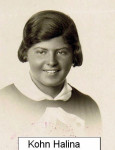
Halina Karin (geb. Kohn, verh. Dębnicka, verh. Nawrocka)
- Born on: 18.2.1917
- Birthplace: Krakow (Kraków),
- Category: Diploma program
- Right of domicile: Neumarkt (Nowy-Targ),
The English version is based on a translation by Artificial Intelligence. The authentic version is the German version.
Childhood and Youth – the Family Background
Halina Karin (until 1937: Halina Kohn) was born on February 18, 1917, in the then Austro-Hungarian Krakow/Kraków. She grew up in Nowy Targ (Neumarkt) in Galicia at the foot of the Tatra Mountains. Her parents were the lawyer Dr. Bernard Kohn (1870–1934) and his second wife Eugenia Scheindel Kohn (née Mandel). During her childhood, the family lived in various rented houses on the Rynek, the central marketplace of the city (Voit 2013; Książka adresowa 1926, p. 31).
Her father Bernard was a respected lawyer and an active member of several Jewish organizations, such as the orthodox-oriented Kehillah of Nowy Targ, the highest non-rabbinical organization of the Jewish community, or the humanitarian lodge B’nai B’rith (Brzoza). In a Hebrew-language chronicle of the predominantly Hasidic Jewish community of Nowy Targ, which had approximately 2,500 members in 1914 (see Rappaport 2009, p. 231), he is described as an apolitical, albeit pious man, who showed interest in everything concerning the Jewish public (Walzer-Fass 1979, pp. 159 f.). The fact that Bernard Kohn was also a member of the Society for Advance Payments Towarzystwo Zaliczkowe, in which both Jewish and non-Jewish Poles provided credit to stimulate industry and trade at relatively favorable interest rates (Brzoza), also shows that he was committed to the common good of his region beyond confessional belonging.
Beyond his local political activities in the city council of Nowy Targ, Bernard Kohn was involved at one point in events that subsequently related to world-historical developments. At the beginning of World War I, the exiled Wladimir Iljitsch Uljanow, who would go down in history under the name Lenin, spent the summer months with his wife Nadezhda Konstantinovna Krupskaya in Poronin, less than 20 kilometers south of Nowy Targ. Two days after Austria-Hungary declared war on Russia, on August 8, 1914, Lenin was summoned by the authorities to Nowy Targ and was arrested there as a Russian on suspicion of espionage (Rappaport 2009, pp. 230 f.; Krupskaya 1930, pp. 100 f.). At the recommendation of the Jewish community of Poronin, Lenin sought legal assistance from Bernard Kohn, who was to represent him in the event of a trial. Kohn turned to the lawyer and later president of the Polish Socialist Party, Zygmunt Marek, as had previously Polish socialists from the region, who then – on August 11 – assisted Nadezhda Krupskaya in writing a letter to Victor Adler, the founder of the Social Democratic Workers' Party of Austria, in Vienna. His intervention with Austrian Interior Minister Karl Freiherr Heinold von Udynski led to Lenin's release on August 19, 1914; subsequently, the communist revolutionary was able to leave for exile in Switzerland (Rappaport 2009, pp. 232-234). In the spring of 1917, about two months after Halina Kohn's birth, with Lenin's return to St. Petersburg (then Petrograd, between 1924 and 1991 Leningrad), one of the conditions for the October Revolution of 1917 was created, which brought the Bolshevik party leader to power.
During her childhood and youth in the resurgent Poland of the interwar period, Halina Kohn was struck by several family tragedies. When she was nine years old, her older brother Adam, on November 8, 1926, challenged Polish reserve officer Mieczysław Szamrak to a duel due to anti-Semitic insults during a joint restaurant visit. Adam, who had passed his high school diploma with distinction in the summer of 1922 at the Nowy Targ Gymnasium, thereafter studied law in Lwów (Lviv/Lemberg, now Ukraine) and had been a member of the Zionist student association Hasmonea, was killed at the age of 23 during the duel in the northern Polish Grudziądz, where he was working at the time as a sales manager in the rubber industry, by a gunshot wound to the head. Although investigations into the case proved difficult due to the seconds and Szamrak remaining silent due to the rumored code of honor, the shooter was sentenced to two years in fortress custody. (Walzer-Fass 1979, p. 160 with incorrect year reference; Gazeta Pohalańska No. 27, July 2, 1922, p. 4; Czas [Kraków], No. 266, November 19, 1926, p. 2; Kurjer Poznański, No. 520, November 10, 1926, p. 4; Kurjer Warszawski, No. 68, March 8, 1928, p. 16; Chwila [Lwów], No. 2754, November 19, 1926, p. 7). The question of whether and to what extent the means of violence that her brother chose in the form of a duel to combat anti-Semitism in Polish society also influenced Halina's willingness to later engage in armed resistance against the Nazi occupiers of her homeland (see below) can only be answered hypothetically.
In Halina's 16th year, 1932, her mother Eugenia died after a long illness that had plagued her since World War I. About Eugenia, it is only known that she grew up with four siblings in Nowy Targ and that her father Jakob Mandel (December 14, 1856 - June 16, 1904) was buried in the Jewish cemetery of this city. By the way, his gravestone is one of the few that survived the desecration of the cemetery by Nazis in 1942 and the subsequent use as a site for mass executions, with which all traces of Jewish life were to be destroyed by the occupying power.
Two years after her mother, Halina also lost her father Bernard, making her an orphan at the age of 18 (Walzer-Fass 1979, p. 160). As such, she attended the state girls' gymnasium in Zakopane, which was nicknamed Szarotka (Edelweiss). She completed her high school diploma there in the summer of 1935. Presumably, Halina had been accommodated for her schooling with her 17 years older half-sister Olga and her husband in Zakopane. Olga was Bernard Kohn's daughter from his first marriage; she had married dermatologist Dr. Szymon Papier from Nowy Targ in 1926, who maintained a practice in Zakopane. Later, during World War II, the couple would flee to Soviet, now Uzbek, Bukhara (Archiwum Akt Nowych [AAN], Aktywiści ZPP w obwodzie Buchara. Życiorysy, kwestionariusze, 2/130/0/1.6/210, fol. 143, 265 f.).
Study at the University for World Trade
With her attained university entrance qualifications, Halina Kohn left the Krakow Voivodeship and enrolled at the University for World Trade in Vienna. Here she was enrolled for the diploma program in business sciences for six semesters between the winter semester 1935/36 and the summer semester 1938. Her free scientific work, which unfortunately is not preserved, was written by Halina on the somewhat clumsy grammatical topic Economic Geography of the Polish Carpathians and Carpathian Foothills – her home region. After Halina had already attended French lessons during her high school years – from a newspaper advertisement in which her father searched for a tutor with a university education in 1932, it can be concluded that she struggled with the language (Nowy Dziennik, August 19, 1932, p. 16) – she passed the language requirement examination after the fourth semester with Very Good, and in English even with distinction. She also successfully completed the language part of the diploma examinations as well as their economic geography-technology part with good results. However, the professor of economic geography and current rector of the university, Bruno Dietrich, rated her considerations of the Carpathian foothills only as satisfactory.
During her studies, Halina was registered at different addresses in Vienna (registration information from the Vienna City and State Archives): initially in Keilgasse 13 (3rd district of Vienna), in October and November 1937 in Edelhofgasse 24 (18th district), in December 1937 in Weimarer Straße 90 (19th district), and in the first half of 1938 in Reithlegasse 6/4b (19th district). Between September 7 and November 7, 1938, she resided at Billrothstraße 18/13 (19th district). In between, she traveled several times to Poland.
Early in 1937, she likely used one of these trips to change her surname. On February 2, 1937, a Polish newspaper reported the application for Halina Kohn's name change to Karska, Kamińska, or Karin. Under the date July 17, 1937, the latter name was entered in her student record at the University for World Trade.
The motivation for the decision for “Halina Karin” remains unclear. While a marriage cannot be ruled out due to the three mentioned options, the reason may be found in her former surname. Derived from the Kohanim, who served at the altar in the Jerusalem temple, the surname Kohn with its variants such as Kohen, Kuhn, or Cohen is one of the most common Jewish surnames; it sometimes indicated an ethnic-religious belonging to Judaism. Halina Karin's name change occurred at a time when Jews in both their Polish homeland and Austria were increasingly marginalized. In Poland, the anti-Semitism of the authoritarian ruling Sanacja movement spread increasingly after the death of the head of state, Józef Piłsudski, in 1935 (Michlic 2006, pp. 73 f.): Between 1935 and 1937, 79 Jewish women and men were killed in anti-Semitic attacks, and over 500 were injured (Gilbert 2002, pp. 20 f.). Anti-Semitism was also endemic and socially acceptable in Austria: In Austrofascism, the barriers for the exclusion of Jews were lowered through the initially concealed anti-Semitism, which spread into countless areas of life (Enderle-Burcel/Reiter-Zatloukal 2018). At Karin's alma mater, the Vienna University for World Trade, “Jewish members of the university found themselves face-to-face with a strong anti-Semitic camp characterized by vertical and horizontal networking” (Koll 2018, p. 843). Additionally, the predominantly German nationalist attitude of the professors (Berger 2017, p. 167), which was also characteristic of her thesis supervisor, Bruno Dietrich, prevailed. Thus, it can be speculated that Halina, as a Pole, as a Jew, and possibly as a woman, was exposed to forms of intersectional discrimination. Whether the extensive anti-Semitism in both countries as well as the view into Nazi Germany was the basis for the name change cannot be proven; it may have formed at least one motive.
In her final year at the University for World Trade, Halina Karin experienced the invasion of the German Wehrmacht in Austria, the establishment of a Nazi regime in this country, the Nazification of all public areas of life, and the eradication of Austrian independence through the integration of the country into the Greater German Empire during the “Anschluss” of Austria (from March 11, 1938). Unlike the Jewish students from Austria and Germany, who were not allowed to take examinations after the “Anschluss” or only in exceptional cases, Halina, as a foreign student, was permitted to take her diploma examination in the winter semester of 1938. However, according to a decree from Nazi Education Minister Oswald Menghin dated March 29, 1938 (Austrian State Archives, Archive of the Republic, Federal Ministry of Trade and Transport, Fasc. 577, File No. 127120), her enrollment was only provisional and could be revoked at any time. Aside from this Sword of Damocles, the atmosphere at the university since the “Anschluss” of Austria was hostile for Jewish students: As publications by Peter Berger and Johannes Koll from 2017 show, and as already mentioned above, the lecturers, albeit to varying degrees, identified with National Socialism; many Jewish students with Austrian and German citizenship were forced to abruptly end their studies (mostly without graduating) or take examinations under significantly higher psychological pressure than their “Aryan” colleagues; Jewish doctoral students were deprived of the traditionally festive doctoral ceremony. Furthermore, news about the widespread disenfranchisement, arrest, robbery, abuse, and partly murder of Jews in the aftermath of the “Anschluss” was certainly not conducive to studying at an Austrian university.
Despite these oppressive circumstances, Halina successfully completed her studies at the University for World Trade. Her diploma was issued on November 10, 1938, a time when in some cities of the Greater German Reich, including Vienna, following the previous “Reich pogrom night,” synagogues were still burning or smoldering, businesses owned by Jews were smashed or severely damaged, and numerous Jews in German imprisonments were brutally mistreated.
The Path to Resistance
Following her studies in Vienna, Halina Karin left Austria and moved to Warsaw, where part of her family lived (Karin de Nawrocki 1979, p. 2). Her uncle Karol Mandel had moved his law practice from Nowy Targ to the Polish capital in 1920. In the Holocaust, he and his wife Stefania were murdered in 1942 in the Ghetto of Krzemieniec in present-day Ukraine.
Shortly after her arrival in Warsaw, Karin joined the “Union of Independent Socialist Youth” (Związek Niezależnej Młodzieży Socjalistycznej, ZNMS). Here she met the later journalist and author Kazimierz Dębnicki (1919–1986) (Karin de Nawrocki 1979, p. 1). Kazimierz, called Kazik, came from a wealthy Warsaw family; his father Leon had set up businesses for the famous chocolate manufacturer E. Wedel throughout Poland as a well-known interior designer. Despite this presumably bourgeois family background, Dębnicki passionately engaged in the socialist youth organization before the war and opposed the Sanacja government. During his medical studies at the University of Warsaw, Kazimierz opposed its anti-Semitic (university) policy, which manifested itself, for example, in the introduction of a numerus clausus for Jews and defended his Jewish classmates (Abramow-Newerly 2018, p. 160). The Catholic Dębnicki, described as a handsome charmer and brilliant speaker, had already been writing for the Jewish children's and youth newspaper Mały Przegląd since the age of 14; it was founded and published by Jewish doctor, author, and educator Janusz Korczak, who was murdered in 1942 in the extermination camp Treblinka and posthumously gained fame and recognition for his commitment to children during the Holocaust. In his first article for Korczak's newspaper, Dębnicki's anger was apparent from the title The Teacher Who Teaches Prejudices, written after his biology teacher had criticized him for sitting at his desk “like a Jew” (Lifton 1991, pp. 230 f.). The convinced communist Igor/Jerzy (Abramow-)Newerly, who took over the editorial office of Mały Przegląd from Korczak in 1930, regarded Dębnicki as a favorite student who often visited his family (ibid.). The following described engagement of Kazimierz Dębnicki during the German occupation of Poland should also be read against the backdrop of his youth years.
With the invasion of the German Wehrmacht into Poland in September 1939, Dębnicki took on his comrade in ZNMS, Halina Karin. As she noted years later in a statement, Kazimierz married Karin, who then took the surname Karin-Dębnicka, to protect her as a Jew from Nazi terror (Karin de Nawrocki 1979, p. 2). Probably a few months after the outbreak of the war, both joined the underground organization Gwardia, which emerged from the ZNMS in December 1939. Regarding the nature of their protective marriage, Halina and Kazimierz seemed to leave their immediate environment unclear: Kazimierz's mentor Igor Newerly's son, the later author and composer Jarosław Abramow-Newerly, retrospectively described Halina and Kazimierz as a couple where the partners complemented each other perfectly – he was evidently unaware that Halina and Kazimierz's marriage had led to a protective marriage. According to his memories, Halina had been a petite, charmingly smiling brunette, a delightful “dark girl” with snow-white teeth, while Kazimierz was blond and always tanned. In any case, the young Jarosław had rather focused on the fascinating bicycles with which the couple visited from the Praga district to the cooperative colony in Żoliborz, the Warsaw quarter of the left intelligentsia where the Newerlys lived (Abramow-Newerly 2018, pp. 160 f.). As their prewar address, Halina later specified Zwycięzców Street in Praga, specifically in the Saska Kępa neighborhood; after the outbreak of war, she also lived with Kazimierz in this part of the city, located east of the Vistula River. Their protective marriage with him kept her safe from the Warsaw ghetto on the other side of the river.
Together, the young couple found employment at the company Georg Binder. This company, headquartered in Berlin, specialized in transporting machines and scrap from Poland to Germany. As the only company in the General Government, Binder KG was tasked with “scouring” machines for the German war economy, which meant searching for usable material (Maschinen-Musterung im GG, August 21, 1943, p. 9). Since this included machines belonging to Jews, Binder was also involved in the “Aryanization,” the systematically conducted theft of Jewish property by the Nazi occupying power (Sakowska 1999, pp. 51 f.).
The Jewish businesswoman (whose official title was the male form “Diplomkaufmann”) Halina Karin-Dębnicka worked at Binder KG as the secretary of the managing director; her husband Kazik worked in the company's warehouse. The two used their employment to contribute to sabotaging German armaments production: Together with other Polish workers, they mixed explosives smuggled into the company's premises into the scrap metal; this was intended to cause the loads to explode upon their arrival in German steelworks. When the danger of being discovered arose, Halina and Kazimierz retreated to Suchedniów, located between Radom and Kielce, after a stay in Lwów. Halina benefited from the fact that, as the secretary to the managing director at Binder, she had been informed in advance about investigations. In Suchedniów, she found a job as a secretary at the tractor factory Tański, whose Technical Director, Engineer Kazimierz Czerniewski, was a cousin of a colleague at Binder (Dębnicka-Nawrocka 1988/1994). As will be shown further below, she was also able to work for the resistance against the Nazi regime and Polish collaborators in Suchedniów.
The Attack on the Casino Near the Warsaw Gestapo
Of particular importance for Halina Karin-Dębnicka's activities as an underground fighter was the contact with Tadeusz Koral (born 1910 in Vilnius, died 2000 in Warsaw), who, like Halina and Kazimierz, belonged to the conspiratorial Gwardia group and had previously been a member of ZNMS. During the German occupation of Poland, Koral played a very significant role in the socialist resistance movement. At the war's onset, he had been wounded several times and suffered a spinal injury, resulting in his captivity. After being transferred to a Warsaw hospital in April 1940 and recovering, he then joined the Gwardia (Grabski/Grudka 2013, p. 14, FN 27). In November and December 1941, Koral was trained to become the head of the sabotage department of the “Polish Socialists” (Polscy Socjaliści, PS), the conspiratorial arm of the Polish Socialist Party (Polska Partia Socjalistyczna, PPS). He himself received the code name “Krzysztof”; his sabotage department was given the code names “Teodor” and “Oskard.” This department was under the command of Leszek Raabe, founder of the Gwardia and member of the Central Committee of the Polish Socialists, as well as Stanislaw Chuboda, the secretary of the PS. In addition to Koral, the department included Włodzimierz Kaczanowski (code name “Michal”) as deputy head, chemist Alfred Drabarek (code name “Fredek”), Ferdynand Grzesik serving as head of intelligence, as well as Kazimierz Dębnicki and Halina Karin (Strzembosz 1983, Oddziały szturmowe konspiracyjnej Warszawy, pp. 63-65 and Czarnecki 1994, p. 5). Halina also took care of the finances of the clandestine grouping (Koral 1994, p. 542). In her role at Georg Binder, she had also issued business travel certificates in the name of the company to her fellow fighters such as Koral, which provided the resistance fighters with protection during inspections and searches (ibid., pp. 542 f.).
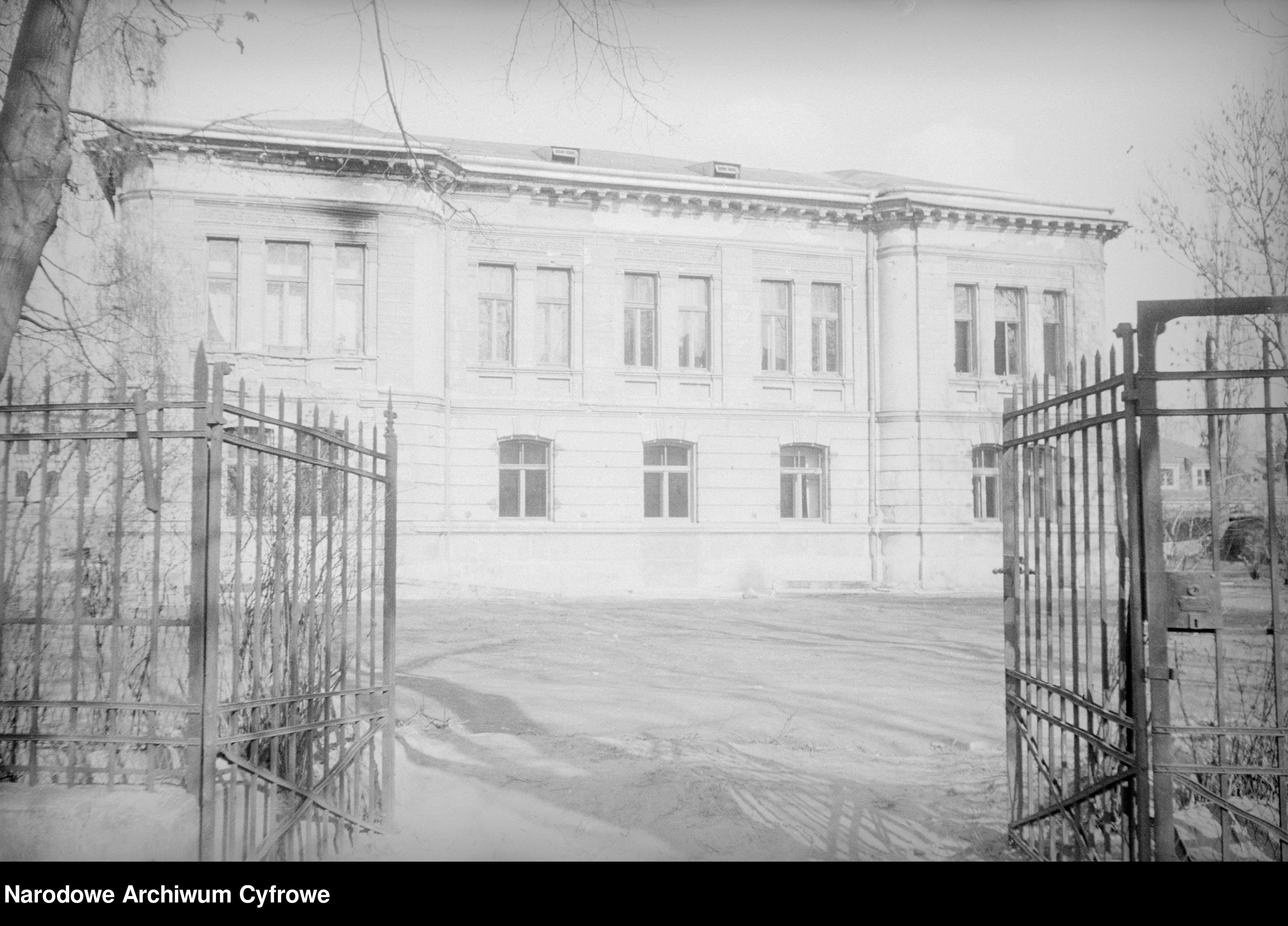
Together with Koral, Halina managed in May 1942 in Warsaw to deliver a spectacular blow against one of the numerous initiatives through which the German occupying power financially exploited the population of the occupied country. Their action targeted the casino in Szucha Alley, located only about a hundred meters from the building of the Secret State Police (Gestapo). Originally built as an officers' mess by the army of the Russian Tsar Empire, to which the so-called Vistula Land including Warsaw belonged until the end of World War I, the building was converted into a garrison casino of the Polish army after the collapse of the Russian Empire and the establishment of the first independent Polish republic (1918/19), which was used for balls, but also for military lectures, conferences, and exhibitions during the interwar period. During the attack of the German Wehrmacht on Poland in September and October 1939, neighboring buildings that had been used by the Polish Ministry of War during the interwar period were hit by bombs. The casino, however, remained unscathed by bomb damage. The facility was opened on October 19, 1940, by the German occupying power as a casino for Poles. According to Warsaw historian Tomasz Szarota, the casino featured elegant dining rooms, baccarat and roulette tables, and a well-stocked buffet where food and drinks were sold at official prices, meaning nearly for free (Szarota 1985, p. 225). It thus attracted patrons among Poles, while access for Germans was officially prohibited. Contemporary observers noted that this did not exclude the possibility that the casino was not least “tapped” by the Gestapo, its immediate neighbor. The Polish resistance repeatedly called for a boycott of the casino because about 40 percent of the daily profits benefited the German occupying authorities, ultimately financing the war machinery of the Nazi state. To discredit players socially, the underground press occasionally published their names.
Since the boycott calls from the Polish resistance did not have the desired effect, its military arm, the Polish Home Army (Armia Krajowa, AK), resorted to violence (for details see also Karin’s own account in Dębnicka-Nawrocka 1988/1994 as well as Koral 1994, especially pp. 548 f.). Tadeusz Koral and Halina Karin-Dębnicka followed a suggestion from the “Union for Armed Struggle” (Związek Walki Zbrojnej, ZWZ), as the Home Army was named until early 1942, when they disguised themselves and used forged identification documents, with Karin posing as the Polish-born German Barbara Zakrewska and Koral as Krzysztof Dziadowski, entering the casino in Szucha Alley in early May 1942 twice. As Karin explained in a 2007 interview, her and Koral's first visit in early May was to scout the premises for a planned attack. The second visit occurred on May 19, 1942. Karin and Koral again entered the casino, this time with a handbag that, unlike a briefcase, did not have to be checked in at the cloakroom but could be taken into the casino. In that handbag was a bomb wrapped in a sweater or newspaper with a time fuse, prepared by chemists Drabarek and Mieczysław Hofman in an underground lab of the PS and set for 11 PM. Although the commander of the Warsaw region of the Home Army, Antoni Chruściel, had instructed them to place the bag under the table of the croupier (Strzembosz 1983, Akcje zbrojne podziemnej Warszawy, pp. 128 f.), Karin and Koral deposited the bomb in the restaurant near their table behind a heavy cherry-colored plush curtain, which adorned a thin plywood wall separating the casino's restaurant from the gaming tables.
While the casino orchestra played the Poème by the Bohemian composer Zdeněk Fibich, the conspiratorial couple had a meal as quickly and inconspicuously as possible near the bomb; as Karin recalled decades later, she had never had a steak go down so heavily in her throat as during that meal (Dębnicka-Nawrocka 1988/1994). In case they “blew their cover” or the operation was jeopardized by an unforeseen event, Karin and Koral each carried a vial of cyanide with them. Fortunately, they did not have to resort to this “radical method of secrecy” (as Koral referred to it on November 13, 1945). For they succeeded in leaving the building after the meal without delay. From a safe distance, Koral and Karin, along with resistance fighters armed with pistols, deployed by the PS for protection near the casino, could observe how the bomb exploded exactly ten minutes later, at precisely 11 PM. A few days later, the underground newspaper Biuletyn Informacyjny, published by the Home Army, reported that the explosion slightly injured several casino visitors and severely injured seven others, one of whom succumbed to their injuries. Sources published later also mentioned fatalities (Koral 1994, p. 549).
The attack carried out by Koral and Karin, both of whom held the rank of lieutenant in the underground at the time (Koral November 13, 1945), was a punishment for – and at the same time a warning against – collaboration of their fellow citizens with the occupying power. Given the proximity of the casino to the Gestapo's headquarters, it also inflicted a significant symbolic blow to the German occupying forces – questioning the inviolability of the latter at a time when a defeat of the German Wehrmacht was not yet apparent. At the same time, the attack took place at a time when news about the deportation of the Jewish population from other Polish ghettos and their killings in Vilnius as well as in newly established extermination camps Chełmno (Kulmhof), Bełżec, and Sobibór reached the Jews in the Warsaw ghetto, leading to an intensification of resistance against the unprecedented crimes against humanity committed by the German occupying power (Sakowska 1999, pp. 212-226). The significance of the attack on May 19, 1942, lies in the fact that it occurred notably before the large Polish uprisings of 1943 and 1944, which were accompanied by increased attacks on Germans, German facilities, and local collaborators (cf. Lehnstaedt 2010, pp. 219-223). Although the Home Army and other Polish resistance organizations had already carried out attacks before, the attack on May 19, 1942, almost directly affected the Gestapo, the core organization of Nazi terror.
The attack carried out by Koral and Karin, with regard to the casino, had no lasting effect. Visitor numbers did drop temporarily after May 19, 1942, to a still considerable level of about 1,200 people per day but then rose again after some time to the pre-attack level. “Only the consequences of a Soviet airstrike on the night of May 12 to 13, 1943, caused a swift decline in visitors.” (Szarota 1985, p. 226). The casino was closed on July 22, 1944, after the operating company had long suffered losses. In 1968, the building was demolished.
Based on current research, it cannot be determined to what extent the attack by Karin and Koral inspired or stimulated other anti-German attacks in the months preceding the Warsaw ghetto uprising (April/May 1943) – for example, the attack carried out by three shock troops of the so-called People's Guard (Gwardia Ludowa) on the night of October 24, 1942, on the German restaurant Café Club, the German railway restaurant of the Mitropa company, and the printing house of the newspaper Nowy Kurier Warzawski, published by the German occupying authorities in Polish (Jędruszczak 1981, pp. 378). After the suppression of the uprising in the Warsaw ghetto, a combat unit of the Home Army attacked the Gestapo prison in the southern Polish town of Jasło on the night of August 5 to 6, 1943, and freed the imprisoned prisoners (Jędruszczak 1981, p. 383).
Although the German security authorities in the General Government achieved many “successes” between 1939 and 1944 against the anti-German resistance (see Borodziej 1999), they apparently never managed to track down the perpetrators of the May 19, 1942, attack and punish them for this act. Moreover, a look at the monthly reports of the Higher Field Command in Warsaw shows that the occupying regime's apparatus could not even assign the attack to the left-wing camp, as it is absent from the list of actions categorized under “communist sabotage actions.” (Bundesarchiv-Militärarchiv Freiburg). Koral was arrested in July 1942 together with Ferdynand Grzesik; however, not due to the attack on the casino, but in connection with instruction in sabotage techniques. Contrary to conflicting statements in some books about Polish Jews in World War II (Korboński 1989, p. 123, likewise but with a different dating Piotrowski 1998, p. 120), Tadeusz Koral survived the end of the war without facing consequences from the Nazi authorities for the May 19, 1942, attack. His arrest, however, led to a path of suffering that brought him to the camps Majdanek, Flossenbürg, Gross-Rosen, Dyhernfurth, Mauthausen, and Ebensee, an outer camp of the KZ Mauthausen, where Polish political prisoners made up the largest group of inmates (Arolsen Archives: Czerniewski). Koral was freed by the American army on May 6, 1945, and returned to Poland in September. Here he actively participated in political life as the deputy voivode of Olsztyn (1945–1948) – that is, as number two in this large administrative district – and as a member of the legislative Sejm (1947–1952) (Grabski/Gruber 2013, p. 14, FN 27).
Further Resistance Activities Against the German Occupation of Poland
After the attack in Warsaw, Halina Karin and her husband could continue to operate sabotage against the German occupying power from the Tański plant in Suchedniów (for further details see [Koral] December 11, 1945). Together with mechanical engineer Stefan Nawrocki (born August 20, 1912, died 1999 at the age of 86), who operated under the code names “Jurek” and “Jur,” and who would become Karina's second husband, machine pistols were distributed from there, secretly manufactured in Suchedniów and other places in the occupied country after the British type “Sten” (later renamed “Jur” in Poland). The production of weapons on the Tański company premises took place in a remote building (Bundesarchiv [BArch] Berlin, p. 6). This was led by the aforementioned Technical Director of the Tański factory, Kazimierz Czerniewski.
The initiative for building and distributing the machine guns in Suchedniów, however, had originated from the regional AK partisan department. This was subordinate to Jan Piwnik, who used the code name “Ponury.” Close links existed between the AK group named after its commander Ponury and the underground workshop in Suchedniów. This is evidenced not least by photographs showing Stefan Nawrocki as a non-commissioned officer responsible for the security of production, handing over weapons (printed in Jedynak/Königsberg/Mróz 2013, p. 96). Nawrocki came from nearby Skarżysko-Kamienna, grew up in modest to poor circumstances, and after dropping out of secondary school and his unfinished training as a mechanical engineer, he worked as a locksmith and welder in railway construction (for this and the following: Syrwid 2018, pp. 324 f.). During the interwar period, the worker sympathized with the PPS, but was not a party member. Just before the outbreak of the war, he had also been employed in a munitions factory – a circumstance that may have benefited the self-taught Nawrocki during the later covert weapon production. With the German attack on Poland, Nawrocki was drafted into the army and fell into German captivity. In the spring of 1940, he was interned in a prisoner of war camp in Westphalia at the so-called War POW Main Camp (short: Stalag) VI J in the Rhineland Krefeld-Fichtenhain. In early 1942, Nawrocki was sent to forced labor, but managed to escape from captivity and make his way to occupied Poland. Initially, he returned to Skarżysko-Kamienna but then worked again as a locksmith in Warsaw. Sought by the German authorities, he left the capital and joined the AK group Ponury in June 1943 in the Radom-Kielce area. In addition, the locksmith Nawrocki was hired under the false name “Henry Bazylewicz” at the Tański factory and participated in the secret manufacturing of the “Sten.”
Halina Karin also confirmed decades later a direct connection between Ponury and the underground workshop: The partisans used the machine guns to attack German military trains running on the nearby railway line between Warsaw and Krakow. Stefan Nawrocki also participated in these attacks. That the occupiers retaliated for these assaults against the village of Michniów, Halina would never forget, as she stated at the age of 93 (Nawrocka 2010). In the village, a few kilometers from the Tański factory, the German Ordnungspolizei killed over 200 children, women, and men in a two-day massacre in July 1943 and destroyed homes and barns; many of the people were shot, stabbed, or – in some cases while still alive – burned. Some residents were taken to concentration camps or drafted into forced labor. The Germans seized livestock and valuables from the murdered villagers. However, the AK group Ponury was not the only recipient of the Sten or Jur machine gun: This weapon was also made available to the resistance fighters of the “Polish People's Army” (Polska Armia Ludowa, PAL) and the Workers' Party of Polish Socialists (Robotnicza Partia Polskich Socjalistów, RPPS), both of which were founded in 1943.
In September 1943, Stefan Nawrocki left the Ponury unit. In hindsight, he justified the decision with the politics of the AK leadership and his desire to seek contact with leftist resistance organizations. In January 1944, he joined the RPPS in Suchedniów, became involved in the local chapter of the PAL, and also collaborated with Alfred Drabarek, the chemist who had prepared the bomb for the casino and was now establishing conspiratorial national councils in the Kielce region (Syrwid 2018, pp. 325 f.). That the contact with Drabarek came about due to mediation through Halina Karin can at least be speculated.
When Stefan Nawrocki joined the RPPS, the workshop where he had met Halina no longer existed. For on October 26, 1943, the Tański factory was “rolled up” by the Gestapo during a raid. The raid can be attributed to betrayal by Jerzy Wojnowski, known as “Motor,” who as a Gestapo agent “Garibaldi”/“Mercedes” conducted espionage close to the command of the Ponury group. After components and plans were found in the workshop during the raid, the company was liquidated; the commercial director and eleven employees were arrested (BArch Berlin, p. 6 f.). Kazimierz Czerniewski suffered particularly hard: Although the Technical Director was on a business trip during the raid, he was captured at a later time, subsequently tortured, and transferred through the concentration camps Gross-Rosen and Mauthausen to KZ Gusen, another outer camp of Mauthausen, where Polish political prisoners constituted the largest group of prisoners (Arolsen Archives: Czerniewski). Piwnik's partisan unit was also affected – presumably also due to Wojnowski's betrayal: two days after the raid against the Tański factory, the German Wehrmacht dealt it a severe blow (Jedynak 2014, p. 34; Maszczyński 1968, p. 353).
Halina Karin-Dębnicki was also among those arrested during the raid. She was imprisoned in Kielce, but was released at an unknown time. Her husband Kazimierz was reportedly said to the authorities that “his wife” was a “devout Catholic”, which presumably saved her life. According to historian Cezary Chlebowski, Halina, along with the also imprisoned Zofia Bielecka, Halina Ludwikowska, and Tadeusz Marcinowski, was released from prison in Kielce in November 1943 with bribes from the Ponury group (Chlebowski 1984, p. 5). However, the exact circumstances of her release cannot be reconstructed according to current research. Nevertheless, it is to be assumed that she would not only not have been released but most likely would have been killed if the German security authorities had been aware of her Jewish descent.
The clandestine arms production was initially moved to Warsaw after the Gestapo raid. However, it returned to Suchedniów in the spring of 1944 ([Koral] December 11, 1945 and Jędruszczak 1981, pp. 386). Retrospectively, Halina Karin humbly regarded her role in weapon production as minor (Halina Nawrocka to Pulkownik, February 28, 1988, in: AAN, Akta Zbigniewa Szczygielskiego, 2/1940/0/4.10/383, also to the following). The activities she described in this context necessitate a relativization: According to her account from February 1988, she secretly delivered the orders “from the forests” – that is, from the partisan groups operating near Suchedniów – hidden in a bicycle frame to Stefan Nawrocki at the Tański factory, smuggled the prefabricated weapons in a suitcase by train to Warsaw for final production, and subsequently transported the finished weapons back for use by the resistance in the forests around Suchedniów – all under the constant danger of being discovered with the messages or the weapons. The fact that the aforementioned raid in October 1943 did not culminate in the immediate execution of the arrested workers can also be attributed to a dispatch Halina made. Accordingly, Kazimierz Dębnicki was said to have received a tip that a search of the Tański premises was imminent. He passed this on to his later wife Stefan, who subsequently evacuated the workshop at least superficially without orders “from the forests” during the aforementioned absence of Czerniewski in great haste, thus possibly saving not only the weapons but also the arrested individuals.
After the War
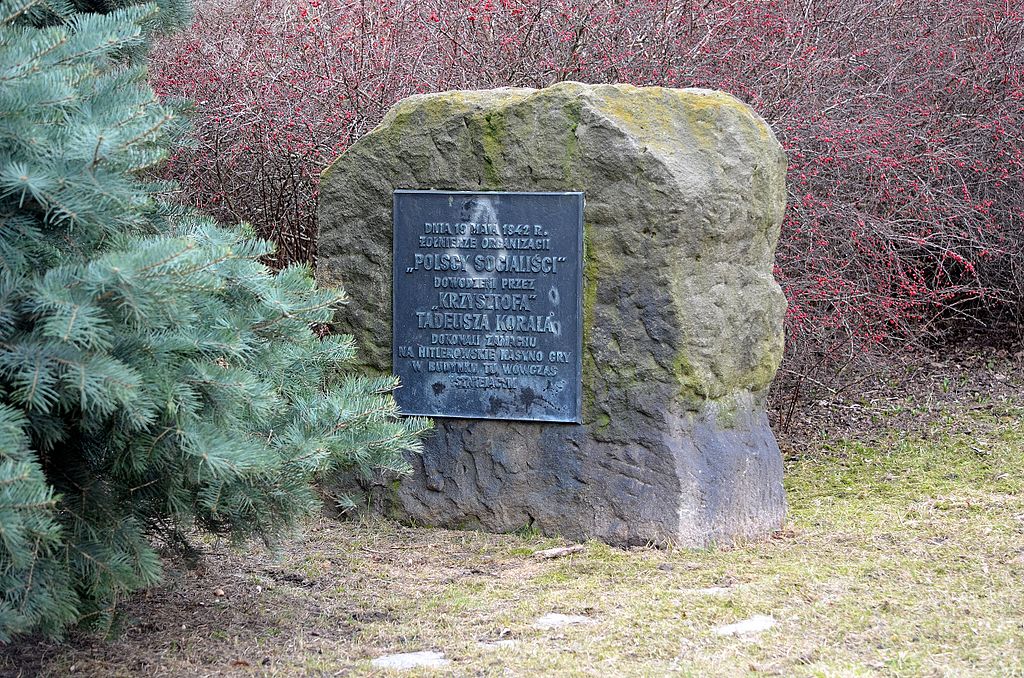
After the end of World War II, Halina Karin was awarded the Cross of Valor for her contribution to the resistance against the Nazi terror regime (Dębnicka-Nawrocka 1988/1994). Notably, her life-threatening resistance against the Nazi regime after 1945 was hardly mentioned. Unlike Tadeusz Koral, her name was not even listed on the memorial stone, which was erected in 1974 on the site of the Warsaw casino demolished in 1968. Its inscription states that “soldiers of the organization 'Polish Socialists' under the leadership of 'Krysztof' Tadeusz Koral” carried out an attack on the building. Halina Karin and her substantial contribution to the attack on the casino, however, fell into oblivion.
The marriage with Kazimierz, which – as explained above – had from the outset taken on the character of a protective marriage, ended by mutual consent. Halina remained on friendly terms with Dębnicki (Karin de Nawrocki 1979, p. 2), but married later – as also mentioned – Stefan Nawrocki. For his involvement in the production of the “Sten” machine guns in Suchedniów, he was promoted to the rank of major, and in May 1946, he was decorated with the Grunwald Cross of the 3rd Class – a distinction awarded “since 1943 by the communist decision-makers for heroic deeds in armed struggle against the German occupier for the freedom and independence of Poland” (Czachur/Loew 2022, p. 34).
On August 18, 1945, Halina gave birth to her son Piotr Nawrocki in the almost completely destroyed Warsaw. In his early years, he grew up under the care of a German-Polish wet nurse and learned German as his first language. At the time of his enrollment in school, he spoke only broken Polish and had to endure various teasing as a result.
His parents Halina and Stefan Nawrocki were initially active in their professional lives in the socialist PPS after the war. As one of the secretaries of Józef Cyrankiewicz, General Secretary of the PPS and from 1947 Prime Minister of the People's Republic of Poland, Halina worked close to the power center of the party (Abramow-Newerly 2003, p. 93). For a time, Stefan returned to work in the railway industry in Warsaw (for this and the following: Syrwid 2018, pp. 326 f.), but soon rose in the PPS hierarchy.
Thus, an old connection of Halina's led to the couple's professional relocation from the Polish capital: In February 1946, Stefan Nawrocki was appointed Starost, the district administrator, in northeastern Poland's Kętrzyn (Rastenburg). The administrative district is located in the Voivodeship of Olsztyn, where, as mentioned, Tadeusz Koral held the second-highest position at that time. While a direct intervention by Koral for Nawrocki's appointment is not documented, a retrospective notation in a confidential, internal party report of the Polish United Workers' Party (Polska Zjednoczona Partia Robotnicza, PZPR) about Stefan from 1949 suggests this connection more than strongly: “When comrade Nawrocki came to our district in 1946, he was under the influence of comrade Koral Krzysztof from Olsztyn, a right-wing PPS member, and his wife [Halina] was secretary of the PK PPS [Powiatowy Komitet = District Committee]” (quoted in Syrwid 2018, p. 327). The classification of a wing of the socialist PPS and its members in the right spectrum must be understood against the backdrop of the power-political directional struggle in post-war Poland. At the end of which was the merger of the communist PPR with the weakened socialist PPS into the PZPR in December 1948 and a clear Stalinist orientation of this governing party. Stefan's taking office as Starost and Halina's membership in the PPS District Committee of Kętrzyn coincided with this period of factional struggles and the beginning of the Stalinization of the People's Republic. In addition to his role as Starost, Stefan was also serving as the chairman of the district committee of the dominant PPS in Kętrzyn until 1948. However, due to the high workload as district administrator, he relinquished this task in the summer of 1947 (Letko 2007, p. 184).
Halina's career and party-political engagement after the war are, however, much more difficult to reconstruct. After her employment in Cyrankiewicz's office, she held a position for some time as a subreferent in the Polish Ministry of Foreign Affairs, which she left in March 1948 at her own request (Ministerstwo Spraw Zagranicznych 1948, p. 9). In December 1946, she listed the house at Kawęczyńska Street 34 in Warsaw – again located in the Praga district – as her residential address, where her brother-in-law Szymon Papier had his medical practice. As her activity in the district committee of the PPS of Kętrzyn is dated to the years 1947/1948 (Letko 2008, p. 226), it is likely that Halina Karin-Nawrocka only moved to northeastern Poland at a later date and traveled back and forth between the capital and Masuria for some time. This would also explain Piotr's upbringing by a nurse.
After a short time, the new shared life as a family and the party-political work of the couple in Kętrzyn was abruptly interrupted (for the following: Syrwid 2018, pp. 326 f.): On March 22, 1949, unknown assailants broke into the Nawrockis' apartment. During the attack, three-and-a-half-year-old Piotr, his cousin, and an older woman – presumably the aforementioned wet nurse – were seriously injured. The background to the act is unknown. Political motives cannot be ruled out due to Stefan Nawrocki's position. Although Nawrocki, according to historical sources, acted as a hard-handed but mediating figure (Letko 2007, p. 182), the power struggles between the PPR and PPS in Kętrzyn were fiercely carried out. Moreover, Halina had emphatically expressed her opposition to the communist party during a meeting of the district committee concerning a reintegration process: “Better non-party than from the PPR” (quoted in ibid., p. 184). She likely would not have welcomed the merger into the PZPR of 1948. A few days after the brutal attack on their apartment, Halina fled the Voivodeship of Olsztyn and returned to Warsaw. Her husband followed her in late summer of the same year.
Notably, after returning to the capital, Halina ceased her professional path in the apparatus of power. She found a position at the Polish National Bank. Her husband applied in August 1949 for his dismissal from Kętrzyn and was appointed a few days later as Starost of the Warsaw-West district. From this time, the aforementioned secret document, questioning his ideological background and recommending that Stefan Nawrocki be placed “under strict supervision and control of the party,” originates (quoted in Syrwid 2018, p. 327); the mention of Halina in this document leaves room for the assumption that she was also under observation. Just three months after his assumption of office in Warsaw, Stefan was expelled from the PZPR and removed from his position. The officially cited basis for this decision was his memberships in AK and PAL during the war. Although Nawrocki regained his party membership after a trial in June 1950 because he had advocated for a united front after the war, his political career lay in ruins. Henceforth, Halina's husband took on various relatively unpolitical but high-ranking positions in the economy, namely in the management of automobile factories and a pressure measuring device factory in Warsaw, Łódź, and Włocławek. Ultimately, he served as the director of the state enterprise for sporting events in Warsaw. At the latest in these years, the decision of Halina and Stefan regarding the emigration described below from the People's Republic of Poland must have been made. In August 1957, Stefan returned his party membership card. Subsequently, he was expelled from the party on October 10, 1957, by decision of the PZPR Central Committee (ibid., pp. 327 f.).
For the Nawrockis, the expulsion from their political offices – irrespective of whether the aforementioned attack was in any way related – as well as the general political turnaround must have felt like a heavy defeat, especially since they had intended to demonstrate great personal commitment to work for the socialist party during and after the war. Whether the disappointments regarding the political developments in Poland after being freed from National Socialism and German occupation were the reason for leaving Poland cannot be established based on current research.
From Poland to Peru
Halina's first husband, Kazimierz Dębnicki, was honored in July 1981 by the Israeli memorial Yad Vashem for saving several Jews during the Holocaust, including Halina Karin, as a Righteous Among the Nations. This honor was preceded by a notarized statement from Karin, which she sent to Israel by airmail from Lima in late 1979. It was the Peruvian capital to which Halina emigated in 1957 with her family. After she had – as shown above – already taken English and French at the University for World Trade, she learned Spanish in Lima. There, she compiled statistics for a U.S. company.
Son Piotr attended an English-speaking school in Lima and studied electrical engineering with a specialization in telecommunications in the USA. In this field, he also became successful after returning to Peru. In 1996, he was appointed Polish Honorary Consul in the Peruvian port city of Callao. In the same year, he became involved in the 126-day hostage crisis at the Japanese embassy in Lima by the underground movement Movimiento Revolucionario Túpac Amaru: During this time, Piotr maintained constant contact with the Polish business attaché held hostage there, and later ambassador to Peru, Wojciech Tomaszewski. Following the bloody storming of the Japanese embassy, Piotr received a letter of thanks from the Warsaw authorities for his involvement (Matuškiewicz de Rivas 2012). He unexpectedly passed away on January 14, 2012, at the age of 66 in Miami.
On October 20, 2013, Halina Karin participated as a guest of honor in the unveiling of a statue honoring Pope John Paul II in the Peruvian city of Lurín. According to the magazine of the Polish diaspora in Peru Gazetka Dom Polski , she had already been friends with Karol Wojtyła, the later Pope John Paul II, in her youth. This can hardly be found in the research; due to the small age difference, the proximity of their places of residence in youth, and Wojtyła's close friendship with Jerzy Kluger, whose father was the chairman of the Jewish committee of Wadownice and a colleague of Halina's father, such an acquaintance can be described as quite possible. The mentioned magazine certainly attests to Halina's participation in the Polish diaspora in Peru – even in old age.
In December 2016, Halina Karin passed away in Peru shortly before her 100th birthday.
Authors: Johannes Koll and Frederik Lange
Support in Research: Regina Zodl and Katharina Graf
Photos
Source material
1. Quellen und Quelleneditionen (chronologische Reihenfolge der Ersterwähnung):
Książka adresowa członków żyd. stow humanitarnego „B´ne B´rith“ w Polsce, Krakau 1926.
Nadezhda K. Krupskaya: Memories of Lenin, Allahabad 1930.
Gazeta Pohalańska, Nr. 27, 2. Juli 1922.
Czas (Krakau), Nr. 266, 19. November 1926.
Kurjer Poznański, Nr. 520, 10. November 1926.
Kurjer Warszawski, Nr. 68, 8. März 1928.
Chwila (Lwów), Nr. 2754, 19. November 1926.
K. Bielawski: Cmentarz żydowski w Nowym Targu, unter: Cmentarze żydowskie, http://cmentarze-zydowskie.pl/nowytarg.htm [7. März 2023].
Z historii I Liceum ogółnokształcącego im. Oswalda Balzera w Zakopanem, http://www.absolwencilo-zakopane.pl/historia.htm [8. März 2023].
Absolwenci „ Szarotki” w Zakopanem – matura 1935 rok, http://absolwencilo-zakopane.pl/absolwenci/1935/index.html [7. März 2023].
Archiwum Akt Nowych (AAN), Aktywiści ZPP w obwodzie Buchara. Życiorysy, kwestionariusze, 2/130/0/1.6/210.
Nowy Dziennik, Nr. 226, 19. August 1932.
Wirtschaftsuniversität Wien, Universitätsarchiv, Studierendenkarteikarte und Alte Prüfungsliste.
Meldeauskunft des Wiener Stadt- und Landesarchivs, GZ MA 8 – B-MEW-396937-2022.
Österreichisches Staatsarchiv, Archiv der Republik, Bundesministerium für Handel und Verkehr, Fasz. 577, Zl. 127120.
Halina Karin de Nawrocki: Testimony (1979), in: Yad Vashem Archives, M.31: Files of the Department of the Righteous among the Nations, File 2017.
Yad Vashem: Shoah Names Database: Karol Mandel, https://collections.yadvashem.org/en/names/13756977 [7. März 2023].
United States Holocaust Memorial Museum (USHMM): Holocaust Survivors and Victims Database, Registration Cards for Jewish Holocaust Survivors: Halina Karin: http://www.ushmm.org/online/hsv/person_view.php?PersonId=8220699 [7. März 2023].
Maschinen-Musterung im GG, in: Warschauer Zeitung, Jg. 5, Nr. 200, 21. August 1943, S. 9.
Halina Dębnicka-Nawrocka: Zamach na kasyno gry, in: Wacław Czarnecki (Hrsg.): Polska Partia Socjalistyczna w latach wojny i okupacji 1939–1945. Księga wspomnień, Bd. 1, Warschau 1994, S. 209 f. [der Text stammt von 1988].
Tadeusz Koral: Akcja sabotażewo-dywersyjna „Polskich Socjalistów“, in: Wacław Czarnecki (Hrsg.): Polska Partia Socjalistyczna w latach wojny i okupacji 1939–1945. Księga wspomnień, Bd. 1, Warschau 1994, S. 537-551.
Carlos Barycki Angulo: Entrevista a Halina Nawrocka (21. Mai 2008 mit undatiertem Nachsatz ab Dezember 2016), in: Dom Polski. Asociación de familias pe-ruano-polacas, http://dompolskiperu.blogspot.com/2008/05/entrevista-halina-de-nawrocki.html [9. Februar 2022].
Carlos Barycki Angulo: Conociendo a nuestros compatriotas: Halina Karin Nandellard de Nawrocki, in: Gazetka Dom Polski, Nr. 17 (Mai 2007), S. 2.
Biuletyn Informacyjny, Jg. 4, Nr. 21 (125) vom 28. Mai 1942, S. 7, unter: http://cyfrowa.chbp.chelm.pl/dlibra/docmetadata?id=4106&from=publication&tab=1 [7. März 2023].; mit Dank an PD Dr. Jochen Böhler (Wien) für den Hinweis.
Tadeusz Koral: Bomba w Kasynie Gry, in: Robotnyk. Centralny organ P.P.S., Nr. 310 (340) vom 13. November 1945, S. 4.
Oberfeldkommandantur Warschau: Monatsbericht für die Zeit vom 16. Mai bis 15. Juni 1942, 23. Juni 1942, in: Bundesarchiv-Militärarchiv Freiburg, RH 53 37, fol. 135–141.
Tadeusz [Koral]: Konspiracyjna produkcja broni, in: Robotnyk. Centralny organ P.P.S., Nr. 348 (378) vom 11. Dezember 1945, S. 4.
Historia suchedniowskiego „Stena“, http://kuznica-suchedniow.com/pliki/plik/historia-suchedniowskiego-stena-1491330114.pdf [7. März 2023].
Karin Nawrocka: Recuerdo de la desesperada lucha de la juventud polaca contra el poderso y cruel ocupante nazi durante la Segunda Guerra Mundial (Años 1939 a 1945), in: Gazetka Dom Polski, Nr. 50 (August 2010), S. 3.
Kurier Kielecki. Specjalna gazeta okolicznościowa, Nr. 19, 11. Juli 2013 (Sonderausgabe), https://ipn.gov.pl/download/1/19263/Kuryer-Calosc.pdf [7. März 2023].
Bundesarchiv Berlin, Reichssicherheitshauptamt, Amt IV: Meldung wichtiger staatspolizeilicher Ereignisse, Nr. 4, 28. Januar 1944, B58 213.
KZ-Gedenkstätte Gusen: Polnische politische Häftlinge, http://www.gusen-memorial.org/de/Das-Konzentrationslager/Haeftlinge/Polnische-politische-Haeftlinge [7. März 2023].
Arolsen Archives, 01012603 036.477: Kazimierz Czerniewski, https://collections.arolsen-archives.org/de/document/1404203 [8. März 2023].
Yad Vashem, The Righteous Among the Nations Database: Dębnicki Kazimierz, File M.31.2/2017, https://righteous.yadvashem.org/?searchType=righteous_only&language=en&itemId=4014512&ind=536 (mit Fotografien) [7. März 2023].
Halina Nawrocka an Pulkownik, 28. Februar 1988, in: Archiwum Akt Nowych (AAN), Akta Zbigniewa Szczygielskiego, 2/1940/0/4.10/383.
Odznaczenia za zasługi położone w walce z okupantem i udział w pracach konspiracyjnych w okresie okupacji. Uchwała Prezydium Krajowej Rady Narodowej z dnia 29 maja 1946 r., http://www.prawo.pl/akty/m-p-1947-51-327,16912968.html [7. März 2023].
Carlos Barycki Angulo: Entrevista a Piotr Nawrocki, 2. Juni 2008, http://dompolskiperu.blogspot.com/2008/06/entrevista-piotr-nawrocki.html [7. März 2023].
Ministerstwo Spraw Zagranicznych: Dziennik urzędowy 30 (1948), Nr. 7.
Teresa Matuśkiewicz de Rivas: Un adiós a Piotr Nawrocki. Conversación con la Sra. Halina Nawrocka, in: Gazetka Dom Polski, Nr. 68 (März 2012), S. 9.
Jerzy Kluger: Interview 49852. Interview by Viviane Teitelbaum. Visual History Archive, USC Shoah Foundation, 10. Juni 1999, https://vha.usc.edu/testimony/49852 (registrierungspflichtig) [8. März 2023].
2. Literatur (alphabetische Reihenfolge):
Jarosław Abramow-Newerly: Lwy wyzwolone, Warschau 2003.
Jarosław Abramow-Newerly: Lwy mojego podwórka Warschau 2018.
Peter Berger: Die Wiener Hochschule für Welthandel und ihre Professoren 1938-1945, in: Johannes Koll (Hrsg.): „Säuberungen“ an österreichischen Hochschulen 1934-1945. Voraussetzungen, Prozesse, Folgen, Wien/Köln/Weimar 2017, S. 153-195.
Włodzimierz Borodziej: Terror und Politik. Die deutsche Polizei und die polnische Widerstandsbewegung im Generalgouvernement 1939-1944 (= Veröffentlichungen des Instituts für Europäische Geschichte Mainz, Abteilung Universalgeschichte, Beiheft 28), Mainz 1999 (polnische Ausgabe: Terror i polityka. Policja niemiecka a polski ruch oporu w GG 1939-1944, Warschau 1985).
Czeslaw Brzoza: The Jews of Nowy Targ in the Inter-War Period, in: The American Association for Polish-Jewish Studies, http://aapjstudies.org/nowy_targ [7. März 2023].
Waldemar Czachur/Peter Oliver Loew: „Nie wieder Krieg!“ Der 1. September in der Erinnerungskultur Polens und Deutschlands zwischen 1945 und 1989 (= Veröffentlichungen des Deutschen Polen-Instituts Darmstadt, Bd. 37), Wiesbaden 2022.
Gertrude Enderle-Burcel/Ilse Reiter-Zatloukal: Einleitende Streiflichter, in: Dies. (Hrsg.): Antisemitismus in Österreich 1933–1938, Wien/Köln/Weimar 2018, S. 17–33.
Regina Fritz/Grzegorz Rossoliński-Liebe/Jana Starek (Hrsg.): Alma Mater Antisemitica. Akademisches Milieu, Juden und Antisemitismus an den Universitäten Europas zwischen 1918 und 1939 – Academic Milieu, Jews and Antisemitism at European Universities between 1918 and 1939 (= Beiträge zur Holocaustforschung des Wiener Wiesenthal Instituts für Holocaust-Studien, Bd. 3), Wien 2016.
Martin Gilbert: The Routledge Atlas of the Holocaust, 3. Aufl. London/New York 2002.
August Grabski/Piotr Grudka: Polscy Socjaliści w getcie warszawskim, in: Kwartalnik Historii Żydow, 2013, Nr. 1, S. 7–31.
Inauguración del monumento y del parque Juan Pablo II en Lurín, in: Gazetka Dom Polski, Nr. 79 (Oktober/November 2013), S. 11.
Tadeusz Jędruszczak: Die antifaschistische Widerstandsbewegung in Polen 1939 bis 1945, in: Jahrbuch für Geschichte, Bd. 23, hrsg. von der Akademie der Wissenschaften der DDR, Zentralinstitut für Geschichte, (Ost-)Berlin 1981, S. 331-416.
Marek Jedynak/Wojciech Königsberg/Szczepan Mróz: Pułkownik Jan Piwnik „Ponury”. Warschau 2013, http://zbrojownia.cbw.wp.mil.pl :8080/Content/2396/Ponury.pdf [7. März 2023].
Marek Jedynak: Dokumenty do dziejów Zgrupowań Partyzanckich AK „Ponury”. Kielce/Krakau 2014.
Johannes Koll: „Da mosaisch zu den Rigorosen nicht zugelassen“. Verfolgung und Vertreibung von Studierenden an der Wiener Hochschule für Welthandel nach dem ‚Anschluss‘ Österreichs, in: Johannes Koll (Hrsg.): „Säuberungen“ an österreichischen Hochschulen 1934–1945. Voraussetzungen, Prozesse, Folgen, Wien/Köln/Weimar 2017, S. 197-241.
Johannes Koll: „Die Vernichtung der jüdischen Lehr- und Lerntätigkeit“. Antisemitismus an den wissenschaftlichen Hochschulen in Wien bis zum „Anschluss“ Österreichs, in: Gertrude Enderle-Burcel/Ilse Reiter-Zatloukal (Hrsg.): Antisemitismus in Österreich 1933–1938, Wien/Köln/Weimar 2018, S. 823–849.
Johannes Koll/Frederik Lange: Sie legte die Bombe im Kasino, in: DIE ZEIT vom 13. April 2023, S. 19, Online-Fassung unter http://www.zeit.de/2023/16/zweiter-weltkrieg-polen-widerstand-halina-karin-attentat [15. April 2023].
Stefan Korboński: The Jews and the Poles in World War II, New York 1989.
Aleksandra Król: The Gestapo Headquarters at Aleja Szucha, in: 39-45. Chronicles of Terror, http://www.zapisyterroru.pl/dlibra/context?id=context7 [18. März 2022].
Stephan Lehnstaedt: Okkupation im Osten. Besatzeralltag in Warschau und Minsk 1939-1944 (= Studien zur Zeitgeschichte, Bd. 82), München 2010.
Paweł Letko: Polska Partia Socjalistyczna w powiecie kętrzyńskim, cz. I, in: Echa Przeszłości 8 (2007), S. 171–191.
Paweł Letko: Polska Partia Socjalistyczna w powiecie kętrzyńskim, cz. II, in: Echa Przeszłości 9 (2008), S. 209–226.
Betty Jean Lifton: Janusz Korczak. Le roi des enfants, Paris 1991.
Jerzy S. Majewski: Al. Szucha: przed wojną kasyno wojskowe, potem jaskinia hazardu, in: Gazeta Wyborcza, 11.01.2015, https://warszawa.wyborcza.pl/warszawa/7,34862,17226559,al-szucha-przed-wojna-kasyno-wojskowe-potem-jaskinia-hazardu.html?disableRedirects=true [18. August 2022].
Tadeusz Maszczyński: Konfrontacje ze współtwórcami historii najnowszej w Kielecczyźnie, in: Rocznik Muzeum Świętokrzyskiego 5 (1968), S. 349-356.
Joanna Beata Michlic: Poland’s Threatening Other. The Image of the Jew from 1880 to the Present. Lincoln (Nebraska)/London 2006.
Tadeusz Piotrowski: Poland’s Holocaust. Ethnic Strife, Collaboration with Occupying Forces and Genocide in the Second Republic, 1918–1947, Jefferson (North Carolina)/London 1998.
Helen Rappaport: Conspirator. Lenin in Exile, London 2009.
Ruta Sakowska: Menschen im Ghetto. Die jüdische Bevölkerung im besetzten Warschau 1939–1943 (= Klio in Polen, Bd. 2), Osnabrück 1999.
Robert Syrwid: Starostowie Warmii i Mazur w latach 1945–1950. Szkice biograficzne. Olsztyn/Białystok/Warschau 2018; für den Hinweis zu dieser Publikation bedanken wir uns bei Dr. Marek Jedynak (Instytut Pamięci Narodowej Białystok).
Tomasz Strzembosz: Akcje zbrojne podziemnej Warszawy 1939–1944, 2. Aufl. Warschau 1983.
Tomasz Strzembosz: Oddziały szturmowe konspiracyjnej Warszawy 1939–1944, Warschau 1983.
Tomasz Szarota: Warschau unter dem Hakenkreuz. Leben und Alltag im besetzten Warschau 1.10.1939 bis 31.7.1944, Paderborn 1985.
Joanna Voit: Kolejny wykład Barbary Słuszkiewicz onowotarskich kamieniczkach, in: podhale24.pl, 21. Januar 2013, https://podhale24.pl/aktualnosci/artykul/22443/Kolejny_wyklad_Barbary_Sluszkiewicz_o_nowotarskich_kamieniczkach.html [7. März 2023].
Michael Walzer-Fass: Sefer Novi-Ṭarg ṿeha-sevivah, o.O. (Israel) 1979.
3. Genealogische Datenbanken (alphabetische Reihenfolge):
Ancestry.com: Einträge zu Halina Karin und Stefan Nawrocki, http://www.ancestry.com (registrierungspflichtig) [9. Februar 2022].
MyHeritage.com: Einträge zu Halina Nawrocki, Karol Mandel, Olga Papier und Eugenia Scheindel Kohn, http://www.myheritage.at/ (registrierungspflichtig) [5. Januar 2023].