

Josef Martin (genannt: Jeff) Grumbach-Palme
- Born on: 19.3.1922
- Birthplace: Vienna (Wien),
- Category: Diploma program
- Right of domicile: Innsbruck (Innsbruck),
The English version is based on a translation by Artificial Intelligence. The authentic version is the German version.
Josef Martin Grumbach-Palme was the son of the Tyrolean artist Josef and Marianne Portitsch. Although he was not of the Jewish faith himself, he was considered 'Jewish' by the National Socialists because his mother belonged to the Jewish religious community. Although his mother escaped the Holocaust, her relatives were robbed, deported to concentration camps, and murdered by the Nazi regime during the 'Aryanization'.
It is not possible to determine when and how long Josef Martin was enrolled at the University for World Trade before the end of World War II due to a lack of sources. However, it is documented that after the end of the war, three semesters were recognized as restitution for him. In the post-war period, he was demonstrably enrolled at the 'University for World Trade' between the summer semester of 1947 and the summer semester of 1948.
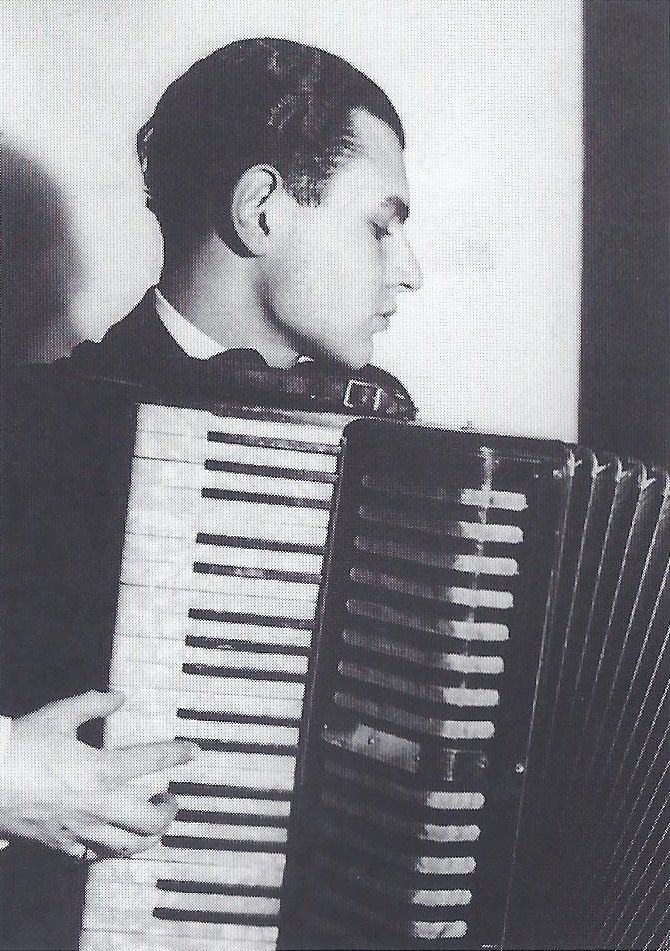
During the Nazi regime, Grumbach-Palme was "a not insignificant personality in the unofficial and conspiratorial jazz scene of Vienna" (Schulz 2008, p. 75). Beginning in 1938, he was an accordionist in Ferry Höndl's orchestra. The start of World War II did not prevent Grumbach-Palme from performing in jazz formations in Vienna, Berlin, and other cities of the 'Greater German Reich'. During an engagement in Hamburg, he and the entire band were once arrested because the musicians - as he later reported - had played "'crooked', 'Yiddish' music. At the police station, we had to jazz for the officers until six in the morning. Before we were allowed to leave, they blessed us with generous gifts." (quoted after ebd., p. 76 f.) Finally, in December 1941, Grumbach-Palme was banned from performing by the Reich Music Chamber. Therefore, he had to earn his living elsewhere: in a forwarding company, a wholesale merchant, and at Siemens AG. However, as he later stated, the companies felt compelled to dismiss him again under political pressure. Despite this, he dared, starting in 1942, to host jam sessions in his mother's apartment twice a week, which were known in relevant circles as "Dämmerstunde bei Jeff". Although jazz was officially condemned for National Socialist cultural policy, he claimed that an SS member was among the musicians who performed at the "Dämmerstunde". Allegedly, during the war, a propaganda department of the SS even recorded with him and the Vienna Rhythm Kings in Vienna-Favoriten. However, there is no independent confirmation for this report. Grumbach-Palme escaped conscription into the Wehrmacht because, on the advice of his uncle Peter, he took pills before his examination. They did not miss their effect: "Before the commission, I thought my head would burst, my heart was beating so fast" (quoted after ebd., p. 81). For this, he was certified unfit for military service. However, he was sent to a so-called military exemption camp located in the castle of Halbturn near Lake Neusiedl. Here, according to his own statements, he did not last long: "I jumped onto a moving train and then resumed my usual activities in Vienna, played the saxophone, and sorted nails and screws in the hardware store Krumpholz." (quoted after ebd.)
With the liberation, his actual career as a musician took an enormous upturn, and in 1971 Grumbach-Palme co-founded and became the first president of the Jazzring Austria. Furthermore, he performed with the Viennese cabaret artist Gerhard Bronner and participated in the film Geheimnisvolle Tiefe (1949). His versatility is evident from the fact that he was involved in the production of the first episode of the show Hausfrau sein dagegen sehr - practical tips for the household, which aired on June 25, 1958, on ORF 1. Finally, Grumbach-Palme also came to public attention as a writer. In 1982, he published the book Konditorei Zauner. Bad Ischl and the Salzkammergut. A small cultural history. The novel Geteilt durch Sieben., which processed Grumbach-Palme's highly lively autobiographical experiences, was posthumously published in 1984.
Grumbach-Palme passed away on August 31, 1983, in Steinbach am Attersee, and on September 21, 1983, he was buried in Vienna at the Döblinger Cemetery.
Author: Johannes Koll
Photos
Source material
Wirtschaftsuniversität Wien, Universitätsarchiv, Studierendenkarteikarte.
Klaus Schulz: Steffl Swing. Jazz in Wien zwischen 1938 und 1945, Wien 2008.
Christian Glanz: Unterhaltungsmusik in Wien im 19. und 20. Jahrhundert, in: Elisabeth Th. Fritz-Hilscher/Helmut Kretschmer (Hrsg.): Wien - Musikgeschichte. Von der Prähistorie bis zur Gegenwart, Wien/Berlin 2011, S. 487-534.
Österreichisches Musiklexikon, http://www.musiklexikon.ac.at/ml?frames=yes [3. Oktober 2013].
E-Mail von Antonia Löwi (Ö1 Service) an Dr. Johannes Koll (Wirtschaftsuniversität Wien) vom 30. Juli 2014.
Friedhöfe Wien, Verstorbenensuche, http://www.friedhoefewien.at/eportal/ep/home.do?tabId=0 [30. August 2013].