

Karl von Kummer
- Born on: 14.11.1916
- Birthplace: Vienna (Wien),
- Category: Diploma program
- Right of domicile: Wien (Wien),
The English version is based on a translation by artificial intelligence. The German version is considered the authentic one.
Karl was the son of Karoline Kapelner, who lived in Neuilly-sur-Seine, later in Vichy (both France). Karl himself lived temporarily during World War II at Hasenauerstraße 6 (19th district of Vienna).
At the University for World Trade, Karl was enrolled between the autumn semester of 1939 and the autumn semester of 1940. He was also recognized for one of the four semesters he studied at the Technische Hochschule Wien starting in 1935 after his high school diploma. In addition, the sixth semester of the degree program was waived for him - possibly due to his participation as a soldier in the Wehrmacht in the conflicts misleadingly referred to as "campaigns" of the Greater German Empire against Poland (September 1939) and the western European countries of France, Belgium, Luxembourg, and the Netherlands. Thus, he was able to take the diploma examination at 'Welthandel' in March 1941 and was officially "exmatriculated" later that month. However, both the studies and the examination were only valid under certain conditions. Because Karl von Kummer was considered a 'Mischling' according to National Socialist views due to his Jewish ancestry, despite his Catholic faith, the approval of the Reich Ministry of Science, Education and Culture (Berlin) was required. This was only granted to him after extended correspondence between the university administration, the curator of Vienna's universities, and the Reich Ministry, and it was granted "revocably". The diploma certificate was issued to him only at the end of October 1942.
Before that, he had given up his apartment on Hasenauerstraße in the second week of April 1942 and moved to Untereichenstein/Rejštejna (Protectorate of Bohemia and Moravia). At an unknown time, he was arrested as a member of the Catholic-German student association Marco-Danubia, which had been established in 1908 as a daughter organization of Norica, had adopted the motto "For Honor and Justice!" (Doeberl et al. 1931, p. 1059), and had taken him in in 1935, and was deported to the Buchenwald concentration camp on the orders of the State Police station in Regensburg on May 12, 1944. Here he received the prisoner number 4990. When von Kummer was forced to undertake work assignments near Weimar on August 24, 1944, he was killed together with 387 other prisoners in an air raid by the 1st Bomber Division of the 8th US Air Force (Stein 2007, pp. 203 ff.). His mortal remains were never found.
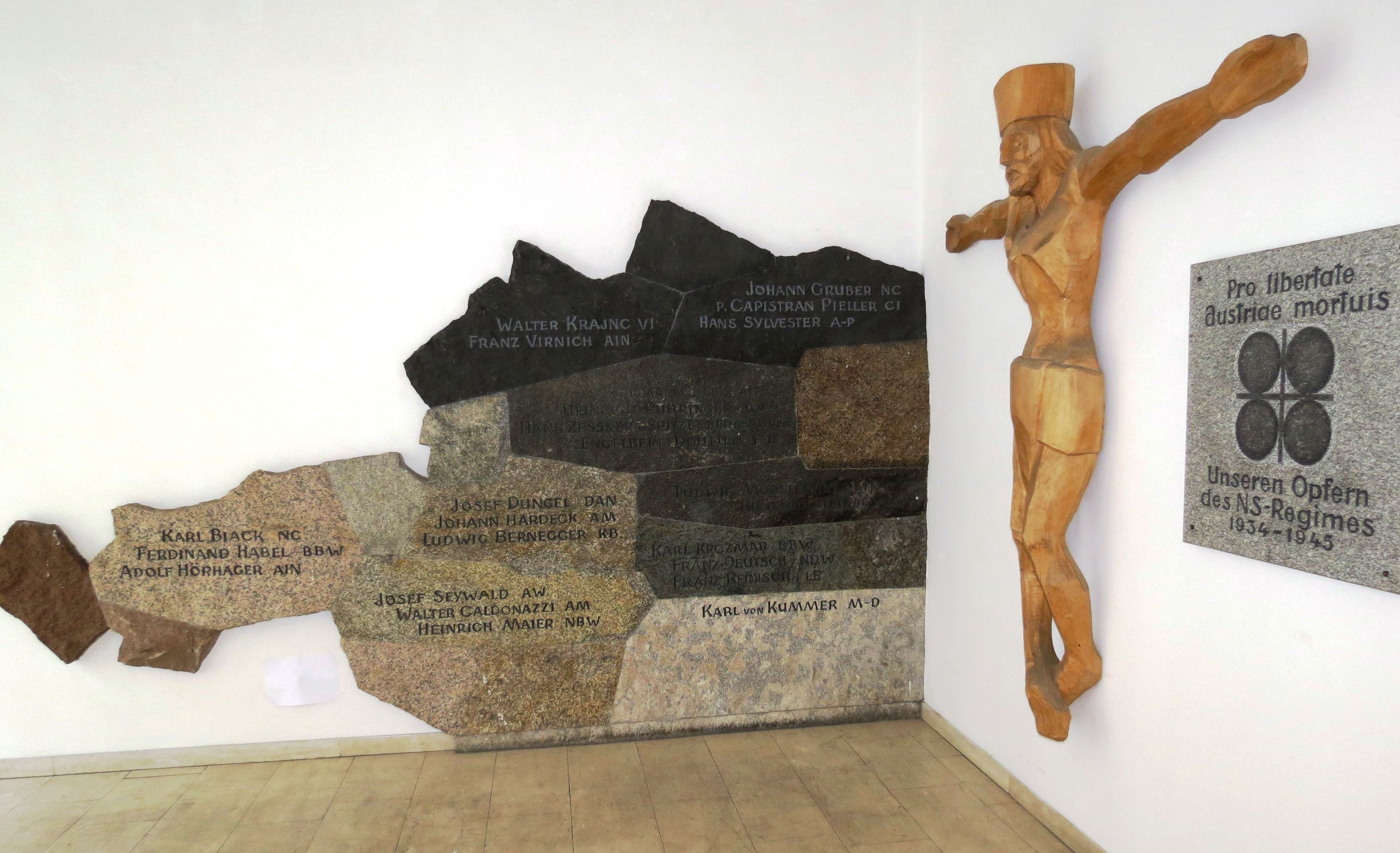
Von Kummer is named on a memorial plaque (see below) that takes the form of a stylized map of Austria, located at the headquarters of the Austrian Cartellverband (Lerchenfelder Straße 14, 1080 Vienna), which commemorates Catholic color students who lost their lives under the Nazi regime.
Author: Johannes Koll
Photos
Source material
Wirtschaftsuniversität Wien, Universitätsarchiv, Studierendenkarteikarte.
Österreichisches Staatsarchiv, Archiv der Republik, 02 Unterricht, Kurator der wissenschaftlichen Hochschulen in Wien, Kart. 13, GZ 5201 ex 1941-1944 (nach Brief von Dr. Herbert Posch und Katharina Kniefacz [Universität Wien] an Dr. Johannes Koll [Wirtschaftsuniversität Wien] vom 13. Februar 2013).
Doeberl, Michael/Otto Scheel/Wilhelm Schlink/Hans Sperl/Eduard Spranger/Hans Bitter/Paul Frank: Das akademische Deutschland, Bd. 2: Die deutschen Hochschulen und ihre akademischen Bürger, Berlin 1931.
Opferdatenbank des Dokumentationsarchivs des österreichischen Widerstands, http://www.doew.at [30. August 2013].
Meldeauskunft des Wiener Stadt- und Landesarchivs, GZ MA 8 – B-MEW – 788024/2013.
Herbert Fritz/Peter Krause (Hrsg.): Farben tragen, Farbe bekennen 1938-1945. Katholische Korporierte in Widerstand und Verfolgung, 2. Aufl. Wien 2013, S. 395.
Krause, Peter/Herbert Reinelt/Helmut Schmitt (Hrsg.): Farben tragen, Farbe bekennen 1938-1945. Katholische Korporierte in Widerstand und Verfolgung, Teil 2, 2. Aufl. Wien 2020, S. 192 f.
Forschungsstelle Nachkriegsjustiz, http://www.nachkriegsjustiz.at/vgew/1080_lerchenfelderstrasse.php [26. August 2013].
Harry Stein: Konzentrationslager Buchenwald 1937-1945. Begleitband zur ständigen historischen Ausstellung, hrsg. von der Gedenkstätte Buchenwald, 5. Aufl. Göttingen 2007.