

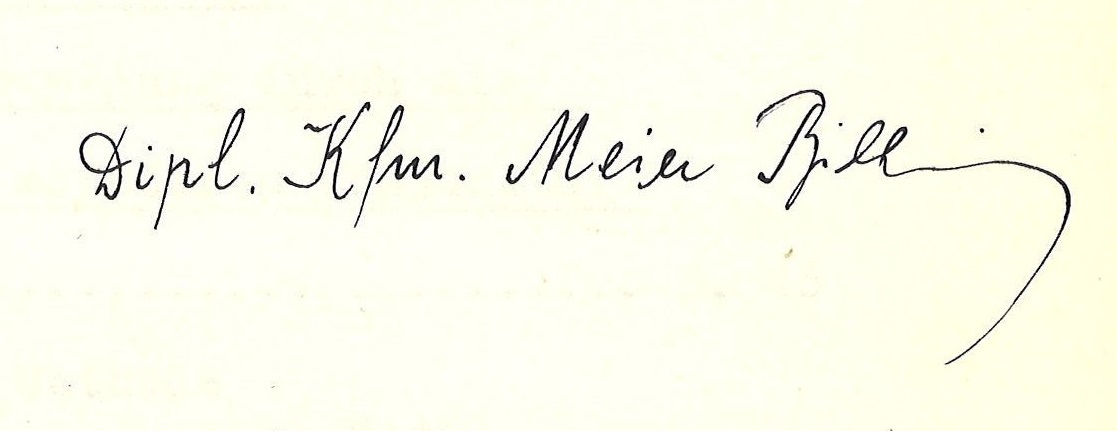
Meier (auch Meier Juda, Max oder Max J.) Billig
- Born on: 11.10.1910
- Birthplace: Gródek Jagielloński
- Category: Doctorate program
- Right of domicile: Wien (Wien),
The English version is based on a translation by Artificial Intelligence. The authentic version is considered the German version.
Meier (occasionally also Meier Juda) Billig was born in 1910 as the son of the merchant Feiwel Billig (born November 2, 1883, in Mostyska/Mościska as the son of Abraham Chaim Billig and Lei Billig, born Eisenberg, died on October 29, 1944, buried a day later at the Beth David Cemetery in Elmont, New York State) in the then Austro-Hungarian city of Gródek Jagielloński, which after World War I would belong to the newly founded Second Polish Republic and would, after the occupation of this part of Poland by the Soviet Union in 1939 and after World War II, become part of Ukraine under the name Horodok. In the same city, Meier's older brother Eisig Billig was born on January 26, 1909. Meier and Eisig had two sisters. Their father Feiwel married Rachela aka Rachel (born May 14 or 15, 1885, in Przemyśl, maiden name Wirt or Wirth) on September 28, 1919, at the Vienna City Temple (1st District, Seitenstettengasse 4).
As a trained tanner and upper garment cutter, the father joined the company Ch.M. Weiser as managing director in 1921, which was thereafter operated under the name Weiser & Billig and was run as a general partnership. The headquarters of the company, which engaged in wholesale leather and leather goods as well as shoe accessories, was initially located at Große Mohrengasse 3b (2nd Vienna District), just a few minutes' walk from the residence at Taborstraße 8; later, it was established at Taborstraße 8/11. In June 1933, Feiwel Billig became the owner of the shoe wholesale business “F. Billig”, which was also located at Taborstraße 8.
Meier enrolled at the University for World Trade for the diploma program after attending an unidentified lower secondary school and the Commercial Academy Vienna I (Akademiestraße 12), and subsequently applied for a doctorate in business sciences at the same university. He was a regular listener at the 'Welthandel' from the winter semester 1929/30 to the winter semester 1933/34 for the required eight semesters and was also registered as an extraordinary listener in the summer semester 1934. During his studies, he lived in his parents' home at Taborstraße 8 but was also registered at Fugbachgasse 3/7 and Leopoldsgasse 22/12. All mentioned addresses belonged to the 2nd Vienna District, the so-called Leopoldstadt, the traditionally Jewish quarter of the city.
Meier Billig took his diploma exam in the autumn and winter of 1932. His dissertation The Influence of Economic Crises by Monopolism, evaluated by the extraordinary professor of economics Walter Heinrich and the regular professor of business administration Karl Oberparleiter, was submitted by Meier in June 1935. For the two presentations required for the doctorate, he chose, alongside the topic Monopoly Price and Competition Price, a topic that allowed for connections to the professional activities of his father: The Costs of Shoe Retailing. However, in November 1935 and March 1936, Meier Billig failed the First Rigorosum twice. A further repetition and admission to the Second Rigorosum were denied to him on January 26, 1942 with the justification: “Since Jewish [,] not admitted to further examinations.” In fact, the Nazi doctoral regulations, which had replaced the doctorate regulations of 1930 effective April 1, 1940, explicitly stated in § 6: “Jews are not admitted to the doctoral examination.” Accordingly, on the cover of the library copy of his dissertation, the handwritten note “mosaisch” was added.
According to his own statements in the questionnaire of the emigration department of the Jewish Religious Community of Vienna, Meier exercised professional activities as a purchasing agent at the companies Del-Ka (DELKA) and “Hermes” F. Hulles shoe selling company, which operated a well-known “Shoe Palace” on Mariahilfer Straße (7th Vienna District), until the 'Anschluss'; he was also managing director of a shoe wholesale company not named, which may possibly have been the paternal business. All of these firms were liquidated or “Aryanized” after the 'Anschluss': The shares of Del-Ka came into the possession of the Creditanstalt-Bankverein in 1940, while “Hermes” was taken over by the Nazis by Hans Proksch and graphic artist Alfred Proksch. The paternal business was deleted from the trade register in December 1938 – as stated in the Zentralblatt für die Eintragungen in das Handelsregister in der Ostmark without reference to the coercive nature of this measure – “as a result of the revocation of business licenses”.
The linguistically gifted Meier Billig, who understood or mastered Polish, German, English, French, Spanish, and Hebrew, managed to emigrate to the USA with his wife Sali (born April 10, 1912, in Pomorzany, maiden name Dier, also called Bini, died June 24, 1990, in New York City). On January 7, 1939, the couple boarded in Antwerp and arrived eleven days later on the S.S. Westernland in New York, where relatives of the Billig family lived. Meier's parents Feiwel and Rachela, as well as his brother Eisig and his wife Klara (born April 29, 1913, in Vienna as the daughter of Israel Marcus and Libe Chasse or Libe Chasie Weisglas), who had married in the Vienna City Temple in 1935 or 1936 and had lived at Lassingleithnerplatz 4 (2nd Vienna District) until the 'Anschluss', were also able to settle in America. Thus, Feiwel and Rachela emigrated to Cuba on February 14, 1939; Eisig and Klara followed nine days later there. In 1940, all four traveled together to New York. Finally, Meier's parents-in-law, Abraham (born ca. 1876) and Berta (born ca. 1886), also managed to escape to the USA in safety from the persecution of Jews in the 'Greater German Reich'.
All of the aforementioned family members were able to save their lives; however, their assets fell largely victim to the typical mechanisms of a bureaucratized robbery for the Nazi regime: Eisig, who was involved in his father's business with a profit-sharing of 20 percent until the 'Anschluss', had to pay taxes and fees of over 7,600 Reichsmark (RM) before leaving the 'Greater German Reich'; in March 1941, the Secret State Police in Vienna confiscated “all of Eisig and his wife Klara's movable and immovable assets as well as all rights and claims” “for reasons of public safety and order with the aim of later confiscation in favor of the German Reich.” Feiwel, whose company had a value of 67,000 RM in July 1938, had to pay a 'Reich Flight Tax' including a 'Surcharge' of over 17,000 RM; this was in addition to more than 3,500 RM for the so-called 'Jewish Asset Tax' and further forced payments. His widow Rachela would receive a modest compensation of 23,000 schillings in the 1960s.
Victim of the Shoah was Klara's father Israel Marcus Weisglas (born June 14, 1888, in the Galician town of Kopyczyńce as the son of Eliukim and Frima or Frime). He lived at Praterstraße 48/14 (2nd Vienna District) until he was deported at an unknown time and was allegedly murdered in the forced labor camp Kamionka Strumiłowa, where around 5,000 Jews were robbed of their lives between 1941 and 1943 (Yones 2018, p. 378).
As evidenced by passenger lists stored on genealogical databases MyHeritage and Ancestry, members of the Billig family traveled multiple times by ship between New York and Cuba during World War II; Meier may have had an apartment or business in Havana. It is also documented that Meier and Sali made numerous trips within America and occasionally to Europe after the war.
According to the census of April 1, 1950, the Billig family, including parents and parents-in-law, at that time lived in a house at Avon Road 186-39 in the Queens district of New York City. The family also included two children, Evelyn (born ca. 1942, later Kenvin, married to Arthur H. Rosenbloom since June 14, 1984) and Peter Charles (born May 25, 1944, in New York, married to Gail Ann Gordon since February 10, 1966, died February 18, 1993, in New York). Later, the Billig family lived directly by Central Park in New York, while his parents lived in the Bronx (1665 Grand Concourse).
From the aforementioned census and other historical sources, it also appears that both Meier and his father-in-law Abraham worked in shoe manufacturing. At that time, Meier was already president of the B. & M. Shoe Company. This company had a factory with about 150 workers and employees in Hoosick Falls (New York State), for which the ground was broken on October 27, 1949 (The American City 1949, p. 125). Until his death, Meier Billig consolidated five companies under the umbrella of the Billig Foundation, which included B. & M. Shoe as well as Billig Shoe and Evy Footwear. Later, Meier's daughter-in-law Gail Billig took over the management of the foundation. In addition, in 1997 she became the first female president of a large Orthodox synagogue in the USA, namely for the Congregation Ahavath Torah in Englewood (New Jersey).
Meier, whose first name is also listed in American sources as Max or Max J., and his wife Sali received American citizenship in 1947. Meier (or Max), who at that time was a grandfather of four grandchildren, passed away on January 17, 1974, at the age of 63 at the Mount Sinai Hospital.
Author: Johannes Koll
Support in research: Katharina Graf
Photos
Source material
Wirtschaftsuniversität Wien, Universitätsarchiv, Studierenden- und Doktoratskarteikarte.
Wirtschaftsuniversität Wien, Universitätsarchiv, Alte Prüfungsliste.
Zentralblatt für die Eintragungen in das Handelsregister in Österreich, 20. Jg., Nr. 17 vom 26. Februar 1921, S. 254, Nr. 4673.
Zentralblatt für die Eintragungen in das Handelsregister in Österreich, 27. Jg., Nr. 27 vom 5. Juli 1933, S. 595, Nr. 11.626.
Meldeauskunft des Wiener Stadt- und Landesarchivs, GZ MA 8 – B-MER-1052642-2017.
Meier Billig: Die Beeinflussung der Wirtschaftskrisen durch den Monopolismus, unveröffentlichte Dissertation, Hochschule für Welthandel 1935, Universitätsbibliothek der Wirtschaftsuniversität Wien, Sign. 40.624-C.
Zentralblatt für die Eintragungen in das Handelsregister in der Ostmark, 38. Jg., Nr. 26 vom 28. Juni 1939, S. 401, Nr. 8146.
Zentralblatt für die Eintragungen in das Handelsregister in der Ostmark, 37. Jg., Nr. 52 vom 28. Dezember 1938, S. 1042, Nr. 16.661.
MyHeritage.at: Österreich, Wien, jüdische Auswanderungsanträge 1938-1939: Fragebögen der Auswanderungsabteilung der Fürsorge-Zentrale der Israelitischen Kultusgemeinde Wien von Meier Juda Billig vom 3. Juli 1938, Nr. 37459, von Feiwel Billig vom 5. Juli 1938, http://www.myheritage.at/ research/collection-11000/osterreich-wien-judische-auswanderungsantrage-1938-1939" rel="nofollow">http://www.myheritage.at/ research/collection-11000/osterreich-wien-judische-auswanderungsantrage-1938-1939 sowie von Eisig Billig vom 5. Juli 1938 [15. und 27. September 2023].
Ancestry.com: U.S. Social Security Death Index, 1935–2014 zum Todesdatum von Sali Billig, http://www.ancestry.com/ [15. September 2023].
Ancestry.com: Passagierliste der S.S. Westernland von Antwerpen nach New York vom 7. Januar 1939 nach: The National Archives and Records Administration; Washington, D.C.; Passenger and Crew Lists of Vessels Arriving at and Departing from Ogdensburg, New York, 5/27/1948 - 11/28/1972; Microfilm Serial or NAID: T715, 1897-1957, http://www.ancestry.com/ [15. September 2023].
MyHeritage.at: Passagierlisten Indizes 1906-1942 nach: The National Archives in Washington, D.C.: New York Passenger Lists, 1906-1942 (National Archives Microfilm Publication T612, 793, record id 100345040_00146_16), Digital Folder Number 100345040, Image Number 146 zu Meier und Sali Billig 1939, http://www.myheritage.at/ [20. Oktober 2025].
MyHeritage.at: Passagierlisten Indizes 1906-1942 nach: The National Archives in Washington, D.C.: New York Passenger Lists, 1906-1942 (National Archives Microfilm Publication T612, 802, record id 100660772_00473_18), Digital Folder Number 100660772, Image Number 473 zu Feiwel, Rachel, Eisig und Klara Billig 1940 http://www.myheritage.at/ [20. Oktober 2025].
Genteam. Die genealogische Datenbank, Index der jüdischen Matriken Wien und Niederösterreich), https://genteam.at , Nr. 196066 und 346524 bzw. Nr. 196067 und 346525 zu Eisig und Klara Billig sowie Nr. 179227 zu Klara Weisglas [27. September 2023].
Österreichisches Staatsarchiv, Archiv der Republik, Bundesministerium für Finanzen, Vermögensverkehrsstelle: Vermögensanmeldung Nr. 7866 von Eisig Billig vom 16. Juli 1938.
Österreichisches Staatsarchiv, Archiv der Republik, Bundesministerium für Finanzen, Vermögensverkehrsstelle: Vermögensanmeldung Nr. 25181 von Feiwel Billig vom 16. Juli 1938.
Österreichisches Staatsarchiv, Archiv der Republik, Finanzen, Hilfsfonds, Abgeltungsfonds 2657.
Opferdatenbanken des Dokumentationsarchivs des österreichischen Widerstandes (http://www.doew.at ) und von Yad Vashem: Zentrale Datenbank der Namen der Holocaustopfer, ID 597998 (https://yvng.yadvashem.org/nameDetails.html?language=de&itemId=597998&ind=1), Einträge zu Israel Marcus Weisglas [29. September 2023].
Eliyahu Yones: Die Juden in Lemberg während des Zweiten Weltkriegs und im Holocaust 1939–1944, Stuttgart 2018.
MyHeritage.at: Volkszählung 1950 der Vereinigten Staaten, http://www.myheritage.at/ research/collection-11006/volkszahlung-1950-der-vereinigten-staaten?itemId=107837566-&groupId=805e1f4fec2c07ad0f653d708b3082a6&action=showRecord&recordTitle=Peter+Billig [27. September 2023].
MyHeritage.at: New Jersey Todes Index, 1920-1929, 1949-2017 zu Peter Charles Billig, http://www.myheritage.at/ research/collection-10747/new-jersey-todes-index-1920-1929-1949-2017 [15. September 2023].
Ancestry.com: The Boston Jewish Advocate Wedding Announcements, 1905–2007 zur Eheschließung von Peter Charles, http://www.ancestry.com/ discoveryui-content/view/47112:1358 [28. September 2023].
The New York Times vom 15. Juni 1984, Section B, S. 4 zur Eheschließung von Tochter Evelyn mit Arthur H. Rosenbloom.
MyHeritage.at: U.S. Behördendaten-Verzeichnis zu 1974, http://www.myheritage.at/ research/collection-10220/us-behordendaten-verzeichnis?itemId=51473041&action=showRecord&recordTitle=Meier+J+Billig [28. September 2023].
The American City, Dezember 1949, S. 125.
Tax-Exempt Foundations and Charitable Trusts: Their Impact on our Economy. Staff Report for the Subcommitee on Domestic Finance of the Committee on Banking and Currency House of Representatives, 8th Installment, 92d Congress, Second Session, Washington August 1972, S. 139.
Abigail Klein Leichman: Leaders Lift Spirit in Orthodox Women’s Section, in: Women’s eNews vom 13.07.2007, https://womensenews.org/2007/07/leaders-lift-spirit-in-orthodox-womens-section/ [9. Oktober 2023].
Myheritage.at: U.S. Einbürgerungsaufzeichnung Meier Juda Billig und Sali Billig, beide nach: The U.S. National Archives and Records Administration (NARA), Index to the Naturalization Petitions of the United States District Court for the Eastern District of New York, 1865-1957, M 1164, http://www.myheritage.at/ research/collection-10024/us-einburgerungsaufzeichnungen [15. September 2023].
The New York Times vom 18. Januar 1974, S. 36.