

Sara Tobolska
- Born on: 13.10.1917
- Birthplace: Lodz (Łódź),
- Category: Diploma program
- Right of domicile: Lodz (Łódź),
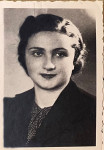
The English version is based on a translation by artificial intelligence. The authentic version is the German one.
Sara Tobolska was the daughter of Jerachim (also: Jeruchim) Tobolski, who was born on July 5, 1884, in Skidel near Grodno (then part of the Russian Empire, now in Belarus) as the son of Abram (also Avraham) Tobolski and Tauba (maiden name Kawecki), and Hinda Tobolska (born 1881 in Gąbin, maiden name Karafka), who were married in Lodz in 1908. She had a brother, Marek (also Marulek, born December 6, 1910, in Lodz).
In her hometown Lodz, Sara attended the Humanistic Gymnasium; at this time, she lived with her family at Aleja Maja 37/8. The parental apartment was not far from the factory located at Ulica Generała Lucjana Żeligowskiego 10, which was owned 65 percent by her parents and 35 percent by maternal relatives, initially Hinda's father Sucher Karafka (1851–1934), and from September 1933 by her brother David Karafka (ca. 1892–?).
After obtaining her high school diploma, Sara Tobolska was enrolled at the University for World Trade for three semesters between the winter semester of 1936/37 and the winter semester of 1937/38. On February 21, 1938, she took her final exam, the first (general) exam; a certificate was issued to her at the end of May 1938. As a Jewish student, she had to leave the university after the 'Anschluss' of Austria. Already on March 15, 1938, she left her apartment at Schultz-Straßnitzky-Gasse 11/6 (9th District of Vienna), where she had been registered during her short studies, and returned to Lodz. The extent of the anti-Jewish and anti-Polish measures she faced there after the German Wehrmacht invaded Poland and Adolf Hitler annexed Lodz to the Warthegau (cf. Bömelburg 2022, Ch. 8 and Friedrich 2011, pp. 32-48) is unknown.
On January 23, 1940, Sara moved from Lodz to Tschenstochau/Czędstochowa, and her father followed on May 27, 1940. She may have traveled from there to Hungary. In any case, she applied for admission to study at the Hebrew University in Jerusalem, which was founded in 1918 with the involvement of Albert Einstein, through the Budapest Palestine Bureau (Erzsébet körút 26) in November 1940. Whether she actually managed to reach Palestine remains unknown, as does her further life path.
It is documented that Sara's father and her brother became victims of the Shoah in the German General Government. The place and date of death of Jeruchim are known: he died on June 1, 1942, in the Zawodzie prison, which the German occupying power had established in Tschenstochau (Pietrzykowski 1983, p. 271). The building of his Lodz factory was taken over by the company E. Seeger & R. Gloger in early 1944.
Also wiped out by the National Socialists was the majority of Jeruchim Tobolski's six siblings' family. One example is his sister Zofia Chaja Sara Faust (born 1891 in Skidel under the maiden name Tobolska): she herself, her husband Jeruchim Faust (born January 4, 1888, in Tschenstochau as the son of Szajndla and Ludwik Lewek), who had worked in a bank in Lodz’s Piotrkowska since 1935, and their daughter Ludwika (born January 9, 1918, in Tschenstochau) were deported during raids in which the National Socialist occupying power, aided by Polish and Ukrainian auxiliary police, arrested Jews, and were presumably gassed in the Treblinka extermination camp in 1942. Only the son of Zofia and Jeruchim Faust, Mieczyslaw Faust (born February 2, 1924, in Tschenstochau, also called Mietek), survived the Shoah and the National Socialist war of annihilation. While still a student at the Jewish Gymnasium of Lodz, Mieczyslaw tried to participate in the defense of his country against the German Wehrmacht in September and October 1939. After the capitulation of the Polish army, he initially returned to his parental apartment in Lodz, but was expelled by the Germans from this central Polish city in late February 1940 along with his family. In Tschenstochau, his father found employment at a brick factory, while Mieczyslaw was able to complete an apprenticeship as an electrician in the city administration there. In February 1941, the Faust family was forced to relocate to the ghetto that the Germans had then set up to concentrate the Jewish population in Tschenstochau. As described above, his closest family members were deported and sent to certain death, while Mieczyslaw managed to hide in the Tschenstochau ghetto, but also in the 'Aryan' part of the city, avoiding detection by the Germans and collaborators. Likely in early 1943, he volunteered to work at the Tschenstochau branch of the Leipzig armaments company HASAG (Hugo Schneider AG), which included thousands of forced laborers and had 26,700 employees by spring 1944, thus comprising 'the largest workforce of all war-important enterprises in the Radom district' (Winter 2025, p. 7). Here, Mieczyslaw was deployed in the Pelcery camp, which the German occupiers had confiscated from the originally Verviers-based textile company Peltzer et fils. He likely faced the catastrophic living and working conditions characterized by hunger, thirst, illnesses, and inadequate clothing, which led to several thousand deaths among the Jewish camp inmates. Fortunately, he managed to escape to Lodz in time before the National Socialists drove the remaining Jewish workers into the Buchenwald concentration camp at the beginning of 1945 with the aim of murdering them as the Red Army advanced. In post-war Poland, Mieczyslaw commenced his studies in Warsaw and earned his living as an engineer. In July 1957, he emigrated to Sweden, where he acquired citizenship. Immediately after his arrival, Mieczyslaw found employment in an electrical company in this Scandinavian country, for which he traveled multiple times to various European countries and four times to Brazil. As the father of a son and a daughter, Mieczyslaw Faust passed away on March 28, 2010, at the age of 86. He was buried in the cemetery of Lidingö (near Stockholm). In the same grave, his second wife Renate (born April 1, 1922) was interred after she passed away on June 5, 2022, at the age of 98.
Author: Johannes Koll
Support in research: Yarden Lenga
Source material
Archiwum Państwowe w Łodzi: Akta miasta Łodzi, Zarząd Miejski w Łodzi 1915-1939, Wydział Ewidencji Ludności, odnaleziono kartę do spisu ludności miasta Łodzi z lat 1916-1921, sygn. 25146, strona 71 [Staatsarchiv Lodz: Akten der Stadt Łódź, Stadtverwaltung Lodz 1915–1939, Abteilung für Bevölkerungsregister, Personenblatt für die Volkszählung der Stadt Lodz aus den Jahren 1916–1921, Sign. 25146, Bl. 71].
Archiwum Państwowe w Łodzi: Akta miasta Łodzi, Zarząd Miejski w Łodzi 1915-1939, Wydział Ewidencji Ludności, sygn. 86608, Ewidencja dowodów osobistych wydanych przez Zarząd Miejski w Łodzi od nr 55001 do 60000, strona 37, poz. 55714 [Staatsarchiv Lodz: Akten der Stadt Lodz, Stadtverwaltung Lodz 1915–1939, Abteilung für Bevölkerungsregister, Sign. 86608, von der Stadtverwaltung ausgestelltes Register, Nr. 55001 bis 60000, Bl. 37, Pos. 55714].
Archiwum Państwowe w Łodzi: Akta miasta Łodzi, Zarząd Miejski w Łodzi 1915-1939, Wydział Podatkowy, sygn. 16255, Księga inwentarzowa nieruchomości m. Łodzi ul. Żeligowskiego z lat 1930-1947, strona 53 [Staatsarchiv Lodz, Akten der Stadt Lodz, Stadtverwaltung Lodz 1915–1939, Steuerabteilung, Sign. 16255, Inventarbuch der Immobilien der Stadt Łódź zur Ulica Żeligowskiego 1930–1947, Bl. 53, Eintrag vom 27.03.1930 mit späteren Modifikationen].
MyHeritage.at: Geni-Weltstammbäume zu Sucher und Dawid Karafka, https://myheritage.at [16. September 2025].
Wirtschaftsuniversität Wien, Universitätsarchiv, Studierendenkarteikarte, Diplomprüfungsliste und Protokoll über die erste (allgemeine) Prüfung an der Hochschule für Welthandel, Bd. 4, Bl. 41.
Meldeauskunft des Wiener Stadt- und Landesarchivs, GZ MA 8 – B-MEW – 173145/2013.
Hans-Jürgen Bömelburg: Lodz. Geschichte einer multikulturellen Industriestadt im 20. Jahrhundert, Paderborn 2022.
Klaus-Peter Friedrich: Einleitung, in: Ders. (Bearb.): Polen. September 1939 – Juli 1941 (= Die Verfolgung und Ermordung der europäischen Juden durch das nationalsozialistische Deutschland 1933–1945, Bd. 4), München 2011, S. 13-56.
Einträge zu Tobolska/Tobolski nach Częstochowa Ghetto Rejestracja für den Zeitraum 22. Januar 1940 bis 7. Januar 1941 und Częstochowa: Registration of Jews coming from other cities to Częstochowa 1940-1941, hier beides aus Czestochowa Archives, Syg. 9061, Nr. 10080, S. 5 (Sara) und Nr. 10696, S. 56 (Jeruchim) bzw. Syg 13797, Nr. 10086, S. 25 (Sara) und Nr. 10919, S. 1 (Jeruchim) nach Częstochowa-Radomsko Area Research Group. Supporting the search for Jewish family history: http://www.crarg.org/ [5. September 2025].
The Central Archive of the Hebrew University, Collection 2100, Admission Requests, 1941.
Yad Vashem: The Central Database of Shoah Victims' Names, Einträge über Jeruhim/Jeruchim/Jerachim Tobolski, ID 1534060, 13047513 und 2033389 sowie über Marek Tobolski, ID 534651, https://collections.yadvashem.org/en/names [4. September 2025].
Jan Pietrzykowski: Więzienie hitlerowskie „Zawodzie“ w Częstochowie, in: Andrzej Szefer (Hrsg.): Więzienia hitlerowskie na Śląsku, w Zagłębiu Dąbrowskim i w Częstochowie, 1939-1945, Kattowitz 1983, S. 210-274.
Częstochowa Book of Permanent Residents 1870-1930, Bd. 6, S. 1031, hier nach Częstochowa-Radomsko Area Research Group. Supporting the search for Jewish family history: http://www.crarg.org/ [5. September 2025].
Yad Vashem: The Central Database of Shoah Victims' Names, Einträge über Zofia Chaja Sara Faust, ID 1008288 und 9272094, Jeruchim Faust, ID 9272093, Ludwika Faust, ID 9272095 und Mieczyslaw Faust, ID 6135055, https://collections.yadvashem.org/en/names [5. September 2025].
University of Southern California, Shoah Foundation: Visual History Archive, Interview 2107 von Miriam Rutiz mit Mietek (Mieczyslaw) Faust vom 20. April 1995 in Los Angeles, https://vha.usc.edu/home [24. September 2025].
Martin Clemens Winter: Besatzungsterror, Zwangsarbeit und Judenmord. Die HASAG im Generalgouvernement, in: Einsicht. Bulletin des Fritz Bauer Instituts 17 (2025), Ausgabe 26 vom 26.11.2025, S. 6-15.
MyHeritage.at: Mieczyslaw Faust in Brasilien, Einwanderungskarten nach Brasilien vom 28. August und 12. November 1975, https://myheritage.at [8. September 2025].
Einträge bei Find a grave zu Mieczyslaw und Renate Faust, https://de.findagrave.com/memorial/250419381/mieczyslaw-mietek-faust und https://de.findagrave.com/memorial/250419550/renate-faust [6. September 2025].