

Eitel Fritz Figge
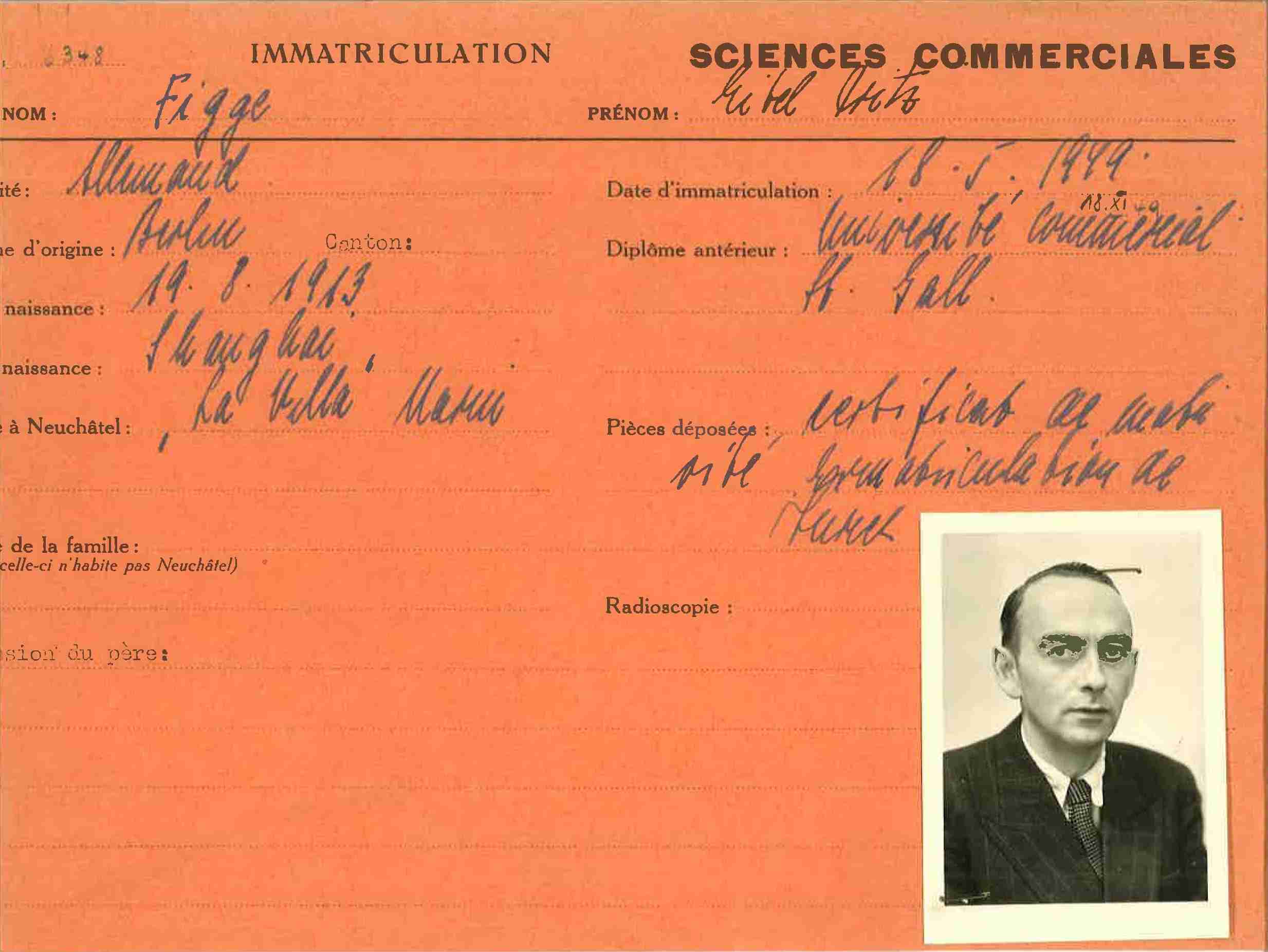
- Born on: 19.8.1913
- Birthplace: Shanghai
- Category: Diploma program
- Right of domicile: Berlin (Berlin),
The English version is based on a translation by Artificial Intelligence. The authentic version is considered to be the German one.
Eitel Fritz was the son of the deceased bank director Heinz and Irene Figge (born December 27, 1880, maiden name Fischer). Until 1926, he attended the Kaiser-Wilhelm-Schule in his birthplace Shanghai, then transferred to the Reform-Realgymnasium Braunschweig. He obtained his high school diploma in 1931 at the Treitschke-Schule in Berlin-Wilmersdorf.
Following his schooling, Figge initially enrolled at the Friedrich-Wilhelms-Universität in Berlin. After moving to Vienna, he attended lectures at the Rechts- und Staatswissenschaftlichen Fakultät of the University of Vienna and was enrolled in the diploma program at the University for World Trade between the winter semester 1936/37 and the winter semester 1937/38. He passed the majority of the exams he took here over the course of three semesters with very good results, receiving the designation “with distinction” multiple times.
In Vienna, Eitel Fritz had been registered since January 1935 at his mother’s apartment at Wipplingerstraße 33/1/10 (1st municipal district). After the German Wehrmacht's invasion, mother and son had to give up their apartment as part of the 'aryanization'; they also lost the assets they had owned in this country up until the 'Anschluss of Austria'. For although Irene and Eitel Fritz were both baptized Protestant, the mother was forced to declare all of her assets. This was based on a regulation from April 1938, which affected not only those whom the Nazis considered Jewish based on the racist definition of the Nuremberg Racial Laws, but also the non-Jewish spouse of a Jew. After Irene Figge had paid the mandatory forced contributions such as the 'Jewish property tax' and the 'Reich flight tax', almost nothing remained of the assets worth over 150,000 Reichsmarks. Even the contributions to the 'Aktion Gildemeester', which enabled her and her son to leave for Zurich, diminished their possessions. Irene could not even cover the shipping costs for those pieces of furniture and other valuables that the Nazi property office had released for relocation to Switzerland after months of back and forth in the spring of 1939. She was forced to have the released possessions auctioned off in Austria under presumably unfavorable conditions in her absence. The modest remainder of 1,316 Reichsmarks, which remained after the deduction of all enforced state contributions and the storage costs for the Vienna shipping company Dr. Franz Reitter, was confiscated in August 1940 by order of the Secret State Police (Gestapo) for the benefit of the German Reich. The once wealthy widow was thus stripped of all her assets in Austria by the Nazi state and, like her son, became a refugee.
Mother and son Figge went into Swiss exile separately in the spring of 1938. Irene was verifiably in Zurich as early as March 20, where she registered a second time on May 12 at the responsible office of the city. It is possible that she returned to Vienna in the meantime to prepare the asset declaration she had to submit due to the aforementioned regulation. In Zurich, she stayed at the elegant Hotel Eden au Lac. From there, she went to Bad Ragaz (Canton of St. Gallen) on July 28, 1938. Eitel Fritz, who also left Austria at an early stage, arrived in Switzerland via Italy. He arrived in Zurich on April 14, the Maundy Thursday of 1938. Like his mother, he initially stayed at the Hotel Eden by Lake Zurich and then changed his residence several times within Zurich. Since these were respectable addresses such as the Grand Hotel Dolder and Hotel Bellerive, it seems that mother and son Figge either received support from relatives or acquaintances in Swiss exile, or they managed to secure foreign assets from the clutches of the rapacious Nazi state.
While his mother ventured back to Shanghai during World War II, Eitel Fritz remained in Switzerland until his death. In November 1940, he moved to St. Gallen, where he lived as a subtenant at various addresses until 1947. At the local Handelshochschule, he continued the studies that had been denied to him in Vienna by the Nazi regime. Here it became apparent that the 'aryanization' of the assets that the Figge family had owned in Austria up until the 'Anschluss' and the particular situation of exile posed serious problems for Eitel Fritz. Thus, the rector of the St. Gallen University reported in the summer of 1942: "Due to the developments of the world war, Mr. Figge has unfortunately been extremely limited in his financial resources and currently receives support contributions from his mother living in Shanghai only with great difficulty. His income from his substantial assets has, however, been completely cut off at this time." Figge financed at least part of his living expenses by giving tutoring lessons. In 1942, he submitted his diploma thesis on the topic Das Teiloligopol als Objekt der Preistheorie und Phänomen der Wirtschaftspraxis ; it was graded with distinction. Figge then pursued a doctoral study, initially in St. Gallen, and from 1949 at the Univesitée de Neuchâtel. However, there is no evidence that he obtained the desired doctorate in business science. In 1943, Figge joined the Academic Association Mercuria San Gallensis; here he adopted the fraternity name Gin.
In connection with the doctoral studies, Figge was regularly registered in Neuchâtel from August 1949, the capital of the Swiss canton of Neuchâtel. From there, he moved again to St. Gallen in November 1952 to complete an internship at the Swiss Institute for Foreign Economic and Market Research of the Handelshochschule. He left St. Gallen at the latest by the end of April 1953. Due to a lack of sources, his further life path cannot be reconstructed. On April 25, 1973, Figge, who had been confronted with health issues since at least the 1940s, succumbed in the Psychiatric Clinic of the Canton of Neuchâtel to a stroke.
Author: Johannes Koll
Downloads
Source material
Wirtschaftsuniversität Wien, Universitätsarchiv, Karteikarte und Diplomprüfungsliste.
Meldeauskunft des Wiener Stadt- und Landesarchivs, GZ MA 8 – B-MEW – 827905/2013.
Österreichisches Staatsarchiv / Archiv der Republik, BMfF, VVSt, VA 40071.
Gabriele Anderl/Edith Blaschitz/Sabine Loitfellner: Die Arisierung von Mobilien und die Verwaltungsstelle für jüdisches Umzugsgut, in: Dies. u.a.: „Arisierung“ von Mobilien (= Veröffentlichungen der Österreichischen Historikerkommission, Bd. 15), Wien/München 2004, S. 164-169.
Meldeauskunft des Stadtarchivs Zürich vom 23. Mai 2014, Sign. V.E.c.100.
E-Mail von Dr. Marcel Mayer (Stadtarchiv St. Gallen) an Dr. Johannes Koll (Wirtschaftsuniversität Wien) vom 28. Mai 2014 unter Bezugnahme auf folgende Bestände: Stadtarchiv St.Gallen, 5/71/156, Nr. 26‘625; 5/71/164, Nr. 39‘075; digitalisierte Einwohnerkartei, 1918 ff.; Offizielles Adressbuch der Stadt St.Gallen, 1947, I. Abt., S. 130; III. Abt., S. 3.
E-Mail von Werner Stiegler (Universitätsarchiv St. Gallen) an Dr. Johannes Koll (Wirtschaftsuniversität Wien) vom 10. Juni 2014.
Staatsarchiv St. Gallen, HSG 320/2339 (Kartei Studierendenakten) und HSG 093/14 (Seminar für Agrarpolitik und Agrarrecht); für die Recherche bedankt sich die Redaktion bei Dr. Thomas Schwabach (Universitätsarchiv St. Gallen).
E-Mail der Contrôle des habitants der Gemeinde Neuchâtel an Dr. Johannes Koll (Wirtschaftsuniversität Wien) vom 4. Juni 2014.
E-Mail von Paul Strasser (Akademische Verbindung Mercuria San Gallensis) an Dr. Johannes Koll (Wirtschaftsuniversität Wien) vom 14. Juni 2014.
Nachrichtenblatt Nr. 35 (Periode 1970 bis 1973) des Altherrenverbandes der Mercuria San Gallensis, S. 97.
E-Mail von Natalie Brunner-Patthey (Université de Neuchâtel) an Dr. Johannes Koll (Wirtschaftsuniversität Wien) vom 19. Juni 2014.