

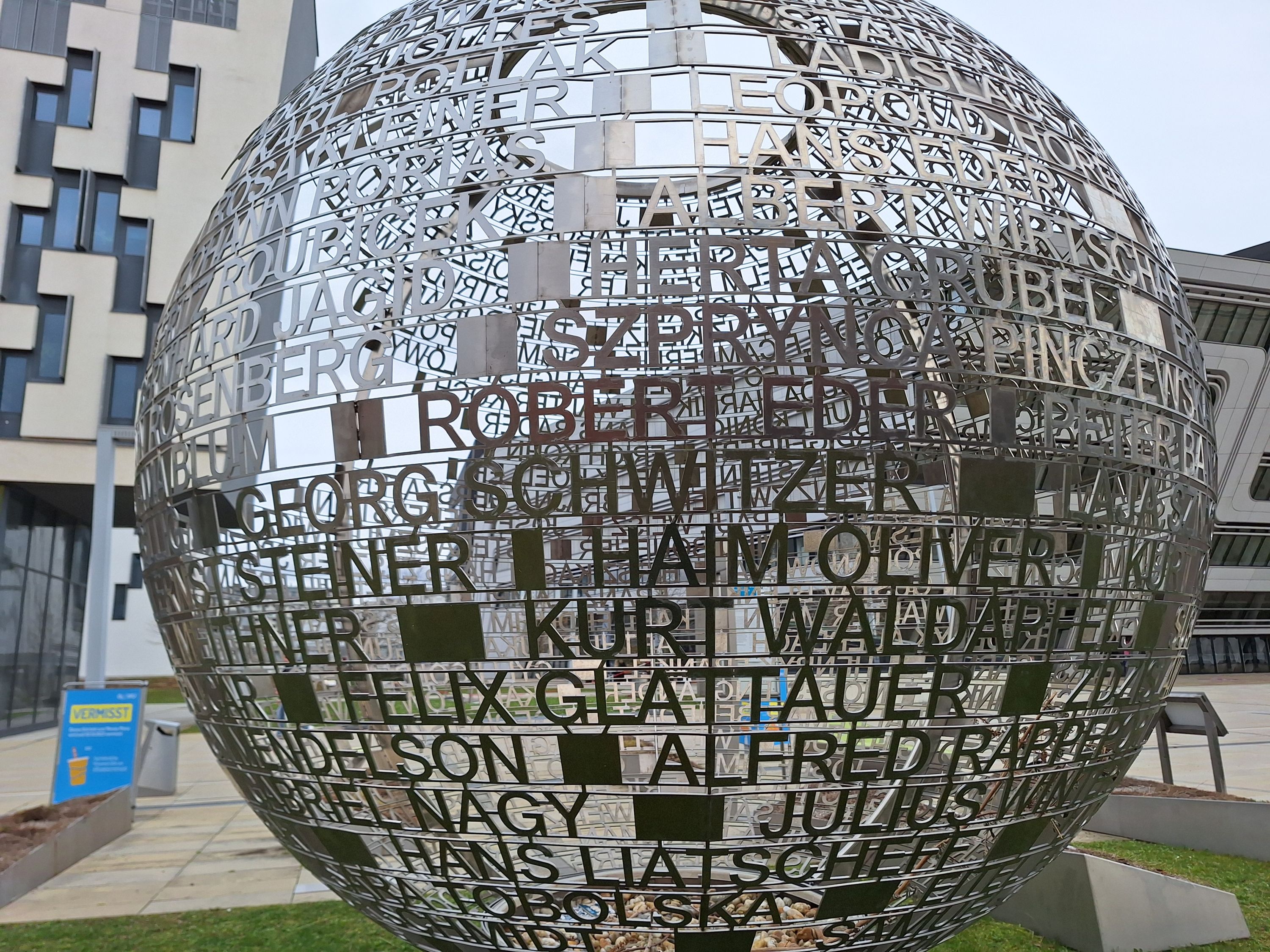
Georg Heinz Schwitzer (später George Swinton)
- Born on: 17.4.1917
- Birthplace: Vienna (Wien),
- Category: Diploma program
- Right of domicile: Wien (Wien),
The English version is based on a translation by Artificial Intelligence. The authentic version is considered to be the German version.
Family, Education, and the 'Anschluss' of Austria
Georg Heinz (also called Gyuri) Schwitzer was the son of the manufacturer Alfred Schwitzer (born August 21, 1884 in Vienna, died April 12, 1937 in Vienna) and his second wife Elisabeth/Erzsébet (maiden name Hellsinger, born April 5, 1884 in Budapest, died September 20, 1970 in Vancouver, Canada). He had a brother, Hans Guido (born November 24, 1919 in Vienna, died December 24, 2007 in Vancouver), and a half-brother, Kurt Rudolf (born March 3, 1915 in Vienna, died 1987), from the first marriage of his father, who married Alice Platschek (called Ally, born January 30, 1894 in Prague as the daughter of Max and Wilhelmine Platschek, died May 27, 1915 in Vienna) on January 6, 1914 in Vienna. His second wife, Georg Heinz's mother, married engineer Alfred Schwitzer on July 15, 1916 in the 5th district of Budapest. The family and household also included Marika (Maria Lujka) Hellsinger (born April 20, 1921 in Budapest, died 2000 in Salzburg) and Gida (Gedeon) Hellsinger (1926 to October 18, 1942 in Budapest), as well as two children from Elisabeth's brother Pál (1882 to 1929) and his wife Lujza Hellsinger (1894 to 1931, maiden name Bernauer), for whom Alfred and Elisabeth exercised guardianship.
Georg Heinz's father was a partner at the company Gustav Ganz & Co. (10th district of Vienna), which had specialized since 1910 in the "production of incandescent lamps and other related articles." In 1927, the factory had about 450 workers. Along with Bernhard Erber, who joined the company as a partner in the summer of 1920, Alfred Schwitzer held a patent for an electric metal wire incandescent lamp since 1914.
Georg Heinz attended the Realgymnasium in the 18th district of Vienna before enrolling for two semesters at the nearby Hochschule für Bodenkultur with a focus on agriculture (Winter semester 1935/36 and Summer semester 1936). He was enrolled at the University for World Trade between the Winter semester 1936/37 and the Winter semester 1937/38. His father Alfred had a connection to the predecessor of this university, the k.k. Export Academy, in that he was a regular member of the association that, starting in 1915, worked towards financing an academy building in Währinger Park.
Georg Heinz did not complete his studies at the 'Welthandel' because, after the 'Anschluss' of Austria in March 1938, he became a victim of racially motivated persecution by the Nazi regime as the son of parents who were deemed 'Jewish' under the Nuremberg Race Laws of 1935. For the fundamentally racially oriented ideology of National Socialism, it was irrelevant that the entire Schwitzer family converted to Protestantism on July 29, 1920, in the parish of Vienna-Währing, according to the Augsburg Confession. The day before, they had left the Israelite Cult Community.
The persecution of the Schwitzer family included the dissolution of the paternal company after the 'Anschluss', which was liquidated by the Berlin "foreign currency advisor" Dr. Hans Schöne and Vienna attorney Dr. Ernst Hoffmann liquidated. Both individuals appear in company boards or supervisory boards of companies that were Nazified and "Aryanized" after the 'Anschluss' (Montan-Union AG, Mühldorfer Grafit-Bergbau AG, Aktiengesellschaft der österreichischen Fezfabriken). Ernst Hoffmann's affiliation with the Nazi regime can also be inferred from the fact that he took over the successful law firm Am Hof 5 (1st district of Vienna) from Dr. Arthur Seyß-Inquart after this National Socialist politician was appointed Austrian Interior Minister in February 1938 under pressure from Adolf Hitler while preparing for the 'Anschluss' (Vienna City and State Archives [WStLA], A1, Vg Vr-Strafsachen, Vg 8 f Vr 6095/48). Moreover, Hoffmann had joined the NSDAP as a member and functionary during the period when the party was banned (June 1933 to March 1938), thus being one of the particularly motivated 'illegal' National Socialists and rising to the officer rank of an Obersturmführer in the SS (WStLA, Personnel files of the Gau Vienna, A1: Dr. Ernst Hoffmann).
The forced interruption of Georg Heinz's studies at the University for World Trade and the 'Aryanization' of the company Gustav Ganz & Co. involved the usual methods of harassment and robbery applied to those whom the Nazi regime considered 'Jewish.' Thus, mother Elisabeth lost nearly all her assets and was forced to "voluntarily" (as an 'Aryanizer' cynically believed he could state) renounce capital investments and claims (Austrian State Archives, Asset declaration Elisabeth Schwitzer). Given a total wealth of over 680,000 Reichsmarks, it was insignificant but very indicative of the systematic state-organized robbery that her automobile, a Fiat 521 worth 650 RM, fell under the 'Aryanization' (Technical Museum Vienna, Vehicle database). Ultimately, Elisabeth Schwitzer had to pay over 170,000 RM, or the usual 25 percent of the total wealth, as 'Reich flight tax', which the Nazi plunder state imposed particularly on Jews escaping from the 'Greater German Reich.' After the family left their home, they were deprived of German citizenship on November 20, 1940, according to the legal provisions that this Reich had implemented shortly after the National Socialist 'seizure of power' in the summer of 1933. Based on this, the German Reich seized the assets of Elisabeth, Kurt, Georg Heinz, and Hans Guido in September 1941.
Through Great Britain to North America. Life and Career in Canada
At this time, the Schwitzer family, who had previously lived at Blaasstraße 13 (19th district of Vienna), had long since been exiled to Great Britain (WStLA, Registration information Georg Heinz Schwitzer). As indicated by the London Gazette from June 1939, the family adopted the surname Swinton in exile. Additional sources indicate that Kurt kept his old first name while Georg Heinz Americanized his name to George, and Hans Guido called himself Anthony Hans or Hans. In British exile, the family found accommodation in De Vere Gardens, not far from Kensington Gardens and Hyde Park.
In 1939, Georg Heinz Schwitzer alias George Swinton came to Canada after the Canadian Crown Council granted him and his brothers immigration approval (Ancestry.com: Canada, Immigrants Approved in Orders in Council. For further details, see especially University of Manitoba Archives & Special Collections; White; University of Manitoba: Honorary Degree recipients, Entry on George Swinton). This part of the British Commonwealth would henceforth be George's center of life, where he would successfully establish himself personally and professionally, both here and temporarily in the United States. He became known as an art historian, art critic, multifaceted artist, and author, who engaged intensively with Inuit art. It was fitting that in 1987 it was said of George Swinton: „He is recognized internationally as the first authority on Inuit Art.“ (University of Manitoba: Honorary Degree recipients, Entry on George Swinton). His expertise in this field was also reflected in the fact that he began collecting artifacts of Inuit culture in 1950, which were later transferred to the Winnipeg Art Gallery and the Art Gallery of Ontario.
However, George Swinton initially devoted five years of service to the Canadian Army. In the Canadian Intelligence Corps, he achieved the rank of captain. Even while serving in the military, which he completed in Canada and the Far East, he engaged in oil and watercolor painting (CBC Times 1961). In 1944, he obtained Canadian citizenship. On August 26, 1943, George married Alice Mantyka, approximately one year younger than him, in Saskatoon, the capital of the Canadian province of Saskatchewan, from whom he divorced in 1970. The marriage produced twin daughters Moira Beth and Nelda Jill in 1953.
In 1946, George Swinton earned a Bachelor of Arts degree from McGill University; he then took courses at the Montreal School of Art and Design (1946–1947) and at the Art Students’ League of New York (1949–1950). At this time, George and Alice Swinton were based in New York, specifically on 75th Street in Manhattan (MyHeritage.at: United States Census 1950).
Already during his education, George worked as a curator at the Saskatoon Art Centre (1947–1949). Between 1950 and 1953, he taught at Smith College (Northampton, USA), which also had an art museum; he subsequently served as an Artist-in-Residence at Queen’s University (Kingston, Canada) for several months. His work and further education were supported—most likely in the 1950s—by a scholarship from the Canada Council for the Arts. In 1954, Swinton was the Assistant Chief of Industrial Design at the National Gallery of Canada in Ottawa. From the autumn of the same year, he taught for twenty years at the School of Art of the University of Manitoba (Winnipeg, Canada), which today manages his estate. At the same university, he additionally served as Head of the Art Collection of the Gallery One One One (now: School of Art Gallery) since its founding in 1965. In this capacity, which he held until 1971, he was primarily responsible for the first art exhibition dedicated to an Inuit artist, specifically the sculptor John Tiktak (1916–1981) in March 1970. From 1974 to 1981, George Swinton served as Professor of Canadian Studies at Carleton University (Ottawa, Canada). He later worked at the same university as an associate professor in the Department of Art History. Upon retiring in 1986, he was awarded the title of "Professor Emeritus". In 1981, Swinton held a visiting professorship at St. Petersburg University.
As an author, George Swinton is especially known for the books Eskimo Sculpture (1965), which was on the Canadian bestseller list for several weeks, and Sculpture of the Eskimo (1972), for which a reviewer highlighted Swinton's "knowledgeable and sensitive comparison of Eskimo and Western concepts of art" and emphasized that Swinton had a critical awareness of the influences that French and English culture in Canada exerted on Inuit art (Andrews 1987, p. 229). In 1992, the book was published in a revised form under the title Sculpture of the Inuit. In addition to these and other books, there are numerous essays and articles published by Swinton in academic and non-academic journals.
In addition to his teaching, academic publishing, and numerous lecture tours inside and outside Canada, Swinton served as an art critic for the Winnipeg Tribune (1954–1958) and was responsible for the television series Art in Action of the Canadian Broadcasting Corporation (1959–1961). Moreover, he repeatedly represented Canadian universities at conferences of UNESCO or the Canadian Centennial Commission (1966/67), was chair of the Canadian Society for Education through Art (1956–1958), and was a member of the National Capital Commission’s Advisory Committee on the Visual Arts. He served on the Board of Governors of the Winnipeg Art Gallery and on the board of the Ottawa School of Art, and as a member of the Canadian Eskimo Arts Council, advised the Canadian government on issues concerning Inuit art and craft (1967–1973). The Inuit Cultural Institute was also among the institutions that Swinton advised (1974–1978).
George Swinton also gained international reputation as an artist. His artworks have been and continue to be exhibited in numerous Canadian and U.S. museums, such as the National Gallery of Canada, the Vancouver Art Gallery, the Winnipeg Art Gallery, the Beaverbrook Gallery, the Confederation Arts Centre, the Etherington Art Centre, or the Glenbow Foundation. By 1987, over 30 exhibitions had been dedicated to his artistic work. Major exhibitions exclusively showcasing his works took place in 1994 and 1997. As an illustrator, Swinton contributed to the poetry collection Red River of the North & Other Poems of Manitoba by Thomas Saunders (1969). He published literary works in 2000 under the title Almost Poems.
Among the honors he received for his contributions to the cultural life and heritage of the exile country that became his chosen homeland is the Centennial Medal, which was issued in 1967 to mark the 100th anniversary of the formation of the Confederation of Canada and awarded around 30,000 times to distinguished individuals in the country. On December 17, 1979, he was inducted into the class of Members of the Order of Canada , which is the second-highest non-military award of the Canadian state after the Order of Merit; the ceremony took place on April 16 the following year. In 1987, the University of Manitoba awarded him an honorary doctorate in law, and in 1992 he received the 125th Anniversary of Canadian Confederation Medal. Shortly before his death, he was awarded the Queen Elizabeth II Golden Jubilee Medal, which was issued in Canada in 2002 to mark the fiftieth anniversary of the British monarch's reign (Goldsborough 2023).
The last six months of his life were spent by Georg Heinz Schwitzer, respectively George Swinton, in the Bethenia Personal Care Home in Winnipeg. He passed away in the same city on April 21, 2002. Instead of a funeral service, the multiple grandfather wished for a "celebration of life" at The Art Collector’s Club in Winnipeg (The Globe and Mail from April 27, 2002).
Family Members
His half-brother Kurt had started to make a name for himself in the world of radio just before the 'Anschluss'. He wrote in the relevant trade journal Radio-Amateur about the basics of electron optics, television receivers, the British Radio Exhibition in London in August 1937, and broadcasting in Great Britain. Kurt Schwitzer was thus already familiar with Great Britain when he sought protection from Nazi persecution there after the 'Anschluss'. He found a position as an engineer at the company Langano Weston Works (Great Cambridge Road, Enfield). Although he was also granted immigration by the Canadian Crown Council, Kurt was interned on June 21, 1940 (Ancestry.com: Great Britain, Foreign Interned Persons in World War II, Kurt Swinton) and was temporarily held in Camp A (later Camp 40) near Farnham (Province of Quebec); this was an internment camp for German prisoners of war and civilian internees who had come to Canada from Great Britain. After being released in 1941 (Vancouver Holocaust Education Center 2012, p. 22), he also joined the Canadian Army. In the Royal Canadian Signal Corps, he rose to the rank of Lieutenant Colonel (Kaufman 2005, p. 46; for further details see The Globe and Mail from May 4/5, 2012). It is documented that Kurt Swinton, in his capacity as an army officer, was temporarily in Great Britain and crossed the Jamaica Producer on October 12, 1942, on behalf of the Canadian Ministry of Munitions from Avonmouth to St. John (Province of New Brunswick) (Ancestry.com: UK and Ireland, Outward Passenger Lists). During his military service, Kurt met Eileen Doris (née Hancock, born October 9, 1917 in Winnipeg, died May 1, 2012 in Toronto) in Ottawa in 1943, who was stationed there with the Canadian Navy at that time. They married on March 4, 1944 (The Gazette from February 28, 1944), and the marriage produced three children (Kathryn, Terence, and Patricia). After the war, they settled in Toronto, both working for the Canadian Institute for International Affairs. In the early 1960s, the family moved to London, where Kurt worked as President of Encyclopedia Britannica International. By the end of the 1960s, New York became their center of life before returning to Toronto.
The youngest brother, Hans, remembered fondly, as mentioned in his obituary, his early years in Austria and never lost his love for his birthplace Vienna (Vancouver Sun and The Province from December 29/30, 2007). Nevertheless, for him as well, Canada became the new home after immigration. Hans Schwitzer studied at the University of British Columbia, engaging in football and golf teams at this university, which was founded in 1908. In 1948, he completed his law degree and opened a law firm specializing in legal advice and representation for small businesses in the same year. Before the 'Anschluss', his enthusiasm for sports had made him a great hope of Austrian golf. Thus, Hans participated in international competitions at the age of just 16, and in 1937, he won the club championship of his club, the Vienna Golf Club, as well as the Central European Inter-Club Wandering Prize. It is documented that in the same year, Hans won first prize in the amateur class at the championship of the Austrian Alpine countries, in front of the Spanish king, the Duke of Alba, and the Duchess of San Antonio (Sport-Tagblatt from September 9, 1937). He took his skills and passion for golf to Canada. The British Columbia Golf Association appointed him as a lifetime director; he was also a member of several Canadian golf clubs. Through the Marine Drive Golf Club in Vancouver, he met Marcia Winona Dorman (born October 27, 1926 in Victoria, died April 27, 2023 in Vancouver). In the spring of 1951, Hans married her (The Victoria Daily Times from May 7, 1951 and Vancouver Sun and The Province from May 6, 2023). The couple would be blessed with three children (Paul, Peter, and Mark). Hans Swinton passed away early on the morning of December 24, 2007, at the Marion Hospice (Vancouver).
From the broader family of Georg Heinz and his brothers, several individuals fell victim to the Holocaust. This includes at least the following family members (for further details, see among others Gaugusch, Vol. 3, 2023, pp. 3555 ff.).
- Georg Heinz's great-aunt Sidonie Schwitzer (born March 12, 1865 in Pest, Hungary, maiden name Spitzer), who had married Sigmund Schwitzer (born September 10, 1862 in Lundenburg/Břeclav, died June 18, 1916 in Franzensbad/Františkovy Lázně) on April 22, 1888, in Vienna, also a partner in the firms H. Schwitzer & Sons, Wellesz & Schwitzer, and Brüder Schwitzer & Co., was deported on July 10, 1942 from the apartment at Köllnerhofgasse 6/7 (1st district of Vienna) to the Theresienstadt concentration camp; here, the mother of one child died on the afternoon of September 29, 1942. According to the death notice of the camp administration, she supposedly died of acute enteritis, an inflammation of the small intestine.
- Also on July 10, 1942, the sister-in-law of Sidonie – and thus another great-aunt of Georg Heinz – was deported to Theresienstadt: Hedwig Schwitzer (maiden name Nossal, born March 11, 1873 in Prague), who had married Hugo Schwitzer (born June 19, 1865 in Lundenburg, died April 21, 1924 in Vienna) on May 27, 1894, in the Vienna Synagogue, also a partner in the firms Brüder Schwitzer & Co., H. Schwitzer & Sons, Wellesz & Schwitzer, and Wellesz, Schwitzer & Co. She was taken from the apartment at Nickelgasse 3/7 (2nd district of Vienna) to the mentioned concentration camp. From there, she was further deported to Auschwitz-Birkenau/Oświęcim on May 15, 1944, where she was killed at an unknown time. By the way, Hedwig was deported together with her 88-year-old mother Mathilde Nossal (born April 1, 1853 near Prague), who had lived with her at Nickelgasse; the elderly woman fell victim to the Nazi regime here on August 28, 1942.
- The commercial employee David Schneider (born December 13, 1872 in the community of Lincs near Tyrnau), who had married Emma Schwitzer (born March 23, 1868 in Lundenburg, died September 25, 1927 at the Viennese Hospital of the Israelite Cult Community) on August 23, 1903, was deported on July 10, 1942 to Theresienstadt from Springergasse 24/5 (2nd district of Vienna). From Theresienstadt, he was further taken to the extermination camp Treblinka on September 21, 1942, where he was killed at an unknown time.
- Finally, Johann (Hans) Alexander Schwitzer (born June 24, 1875 in Vienna), who had lived as a railway inspector in Weidling near Klosterneuburg, was also deported from Springergasse 24 in the 2nd district of Vienna to Theresienstadt on July 14, 1942. He was killed on February 23, 1943.
Author: Johannes Koll
Support in research: Katharina Graf and Stefanie Lucas
Photos
Source material
Wirtschaftsuniversität Wien, Universitätsarchiv, Studierendenkarteikarte und Alte Prüfungsliste.
Georg Gaugusch: Wer einmal war. Das jüdische Großbürgertum Wiens 1800-1938, Bd. 3 (= Jahrbuch der Heraldisch-Genealogischen Gesellschaft „Adler“ – Wien, 3. Folge, Bd. 18), Wien 2023, S. 3554-3561.
Geni.com und MyHeritage.com zu Marika und Gida Hellsinger, http://www.geni.com und http://www.myheritage.com [Zugriffe: 19. März 2024].
E-Mail von Tarik Gafaar, Msc. Mag. (Universitätsarchiv der Universität für Bodenkultur, Wien) vom 9. Februar 2024 an PD Dr. Johannes Koll (Wirtschaftsuniversität Wien).
Die k.k. Exportakademie in Wien. Zur Erinnerung an die Eröffnung des neuen Akademiegebäudes im Herbst 1916, Wien 1916, S. 161.
GenTeam. Die genealogische Datenbank, https://genteam.at [22. März 2023], Austritte in Wien aus der IKG 1915-1945: Alfred und Elisabeth Schwitzer, Nr. 22098 und 22099.
Wiener Stadt- und Landesarchiv, A1, Vg Vr-Strafsachen, Vg 8 f Vr 6095/48: Gertrude Seyß-Inquart, Erklärung von Dr. Ernst Hoffmann und Dr. Walther Richter.
Wiener Stadt- und Landesarchiv, Personalakten des Gaues Wien, A1: Dr. Ernst Hoffmann.
Deutscher Reichsanzeiger und Preußischer Staatsanzeiger, Nr. 276 vom 23. November 1940, Abendausgabe, S. 2, Nr. 162-165.
Meldeauskunft des Wiener Stadt- und Landesarchivs, GZ MA8 – B-MEW-819148/2013.
Österreichisches Staatsarchiv, Archiv der Republik, Entschädigungs- und Restitutionsangelegenheiten, Vermögensverkehrsstelle, Vermögensanmeldungen Nr. 7225 (Elisabeth Schwitzer), 7223 (Georg Schwitzer), 7224 (Kurt Schwitzer) und 7222 (Hans Schwitzer).
Technisches Museum Wien: KFZ-Datenbank, Eintrag zu Elisabeth Schwitzer, http://www.technischesmuseum.at/kfz-datenbanken [27. Februar 2024].
Meldeauskunft des Wiener Stadt- und Landesarchivs, GZ MA8 – B-MEW-819148/2013 zu Georg Schwitzer.
The London Gazette vom 9. Juni 1939, S. 3883.
Ancestry.com: Canada, Immigrants Approved in Orders in Council, 1929-1960, List Number 1644; Reel T-5114, Einträge zu Georg, Kurt und Hans Guido Schwitzer, http://www.ancestry.com/ [1. März 2024].
University of Manitoba Archives & Special Collections: Finding Aid: George Swinton fonds (MSS 210), https://umlarchives.lib.umanitoba.ca/downloads/george-swinton-fonds.pdf [14. Februar 2024].
Linda White: Manitoba Archival Information Network: Swinton, George, Finding Act von Dezember 2007, überarbeitet im November 2021 von Nicole Fletcher, https://main.lib.umanitoba.ca/swinton-george [14. Februar 2024].
University of Manitoba: Honorary Degree recipients, Eintrag zu George Swinton, https://umanitoba.ca/governance/honorary-degree-recipients-1976-1989 [14. Februar 2024].
He Wants You to Enjoy Nature, in: CBC Times. Radio & TV Programs 14 (1961), Nr. 31 vom 21. Juli 1961, S. 2.
MyHeritage.at: Stammbaum Georg Heinz Schwitzer, http://www.myheritage.at/ [22. März 2023].
MyHeritage.at: Volkszählung der Vereinigten Staaten 1950: George und Alice Swinton, http://www.myheritage.at/ [22. März 2023].
Audrey Andrews: Rezension über Swintons „Sculpture of the Eskimo“ in: Arctic. Journal of the Arctic Institute of North America 40 (1987), H. 3, S. 228 f.
Gordon Goldsborough: Memorable Manitobans: George Swinton (1917–2002), http://www.mhs.mb.ca/docs/people/swinton_g.shtml [16. Februar 2024].
George Swinton Obituary, in: The Globe and Mail vom 27. April 2002, http://www.legacy.com/ca/obituaries/theglobeandmail/name/george-swinton-obituary?id=41745728 [20. Februar 2024].
Kurt Schwitzer: Grundlagen der Elektronenoptik, in: Radio-Amateur. Radio – Tonfilm – Fernsehen, 14 (1937), Folge 10, S. 547-550.
Kurt Schwitzer: Radio Olympia. Die englische Rundfunkausstellung in London, in: Radio-Amateur. Radio – Tonfilm – Fernsehen, 14 (1937), Folge 11, S. 603-605.
Kurt Schwitzer: Fernsehen in England, in: Radio-Amateur. Radio – Tonfilm – Fernsehen, 14 (1937), Folge 12, S. 700-703.
Kurt Schwitzer: Der Fernsehempfänger, in: Radio-Amateur. Radio – Tonfilm – Fernsehen, 14 (1937), Folge 12, S. 704-708.
Eileen Swinton Obituary, in: The Globe and Mail vom 4./5. Mai 2012, http://www.legacy.com/ca/obituaries/theglobeandmail/name/eileen-swinton-obituary?id=41516324 [2. Februar 2024].
Ancestry.com: Großbritannien, ausländische Internierte im 2. Weltkrieg zu Kurt Rudolf Schwitzer aus: The National Archives (Kew), HO 396 WW2 Internees (Aliens), Index Cards 1939-1947, http://www.ancestry.com/ [26. Februar 2024].
Ancestry.com: UK and Ireland, Outward Passenger Lists, 1890-1960 aus: The National Archives (Kew), BT27 Board of Trade: Commercial and Statistical Department and Successors: Outwards Passenger Lists; Reference Number: Series BT27-156140 zu Kurt Rudolf Swinton, http://www.ancestry.com/ [26. Februar 2024].
Vancouver Holocaust Education Center: „Enemy Aliens“. The Internment of Jewish Refugees in Canada, 1940-1943, Vancouver 2012, https://vhec.org/images/pdfs/Zachor_Spring2012_EnemyAliensIssue.pdf [23. Februar 2024].
Fred Kaufman: Searching for Justice. An Autobiography, Toronto/Buffalo/London 2005.
The Gazette (Montréal) vom 28. Februar 1944, S. 14, hier nach Ancestry.com: Kanada, Newspapers.com Heiratsindex, 1800-heute, http://www.ancestry.com/ [26. Februar 2024].
Vancouver Sun and The Province vom 29/30. Dezember 2007, Anthony Swinton Orbituary, http://www.legacy.com/us/obituaries/legacyremembers/anthony-swinton-obituary?id=46045501 [21. Februar 2024].
The Students of the University of British Columbia (Hrsg.): The Totem 1941, Vancouver o.J., S. 112.
Neues Wiener Journal, 44. Jg., Nr. 15383 vom 16. September 1936, S. 12 zu Hans Schwitzer.
Sport-Tagblatt. Sport-Ausgabe des Neuen Wiener Tagblattes, Nr. 169 des 71. Jg. vom 21. Juni 1937, S. 4 zu Hans Schwitzer.
Neues Wiener Tagblatt. Demokratisches Organ, Nr. 250 des 71. Jg. vom 10. September 1937, S. 11 zu Hans Schwitzer.
Sport-Tagblatt. Sport-Ausgabe des Neuen Wiener Tagblattes, Nr. 249 des 71. Jg. vom 9. September 1937, S. 4 zu Hans Schwitzer.
The Victoria Daily Times vom 7. Mai 1951, S. 15, hier nach Ancestry.com: Canada, Newspapers.com™ Marriage Index, 1800s-current, http://www.ancestry.com/ [26. Februar 2024].
Vancouver Sun and The Province vom 6. Mai 2023, Orbituary Marcia Swinton, https://vancouversunandprovince.remembering.ca/obituary/marcia-swinton-1087526752 [26. Februar 2024].
Opferdatenbank des Dokumentationsarchivs des österreichischen Widerstandes (http://www.doew.at ), Eintrag zu Sidonie Schwitzer [23. Februar 2024].
Institut Terezínské iniciativy: Todesfallanzeige Sidonie Schwitzer vom 29. September 1942, http://www.holocaust.cz/de/opferdatenbank/opfer/58323-sidonie-schwitzer/ [13. Juni 2025].
Yad Vashem: Zentrale Datenbank der Namen der Holocaustopfer, Eintrag zu Hedwig Schwitzer, ID 4799941, https://yvng.yadvashem.org/index.html?language=de [23. Februar 2024].
Yad Vashem: Zentrale Datenbank der Namen der Holocaustopfer, Einträge zu David Schneider, ID 1098457 und ID 4801206, https://yvng.yadvashem.org/index.html?language=de [23. Februar 2024].
Opferdatenbank des Dokumentationsarchivs des österreichischen Widerstandes (http://www.doew.at ), Eintrag zu Johann Schwitzer [23. Februar 2024].
Yad Vashem: Zentrale Datenbank der Namen der Holocaustopfer, Einträge zu Johann Schwitzer, ID 4946578 und 4800093, https://yvng.yadvashem.org/index.html?language=de [23. Februar 2024].